

Single-Member LLC vs Multi-Member LLC: Key Differences Explained
Should you run your business solo, or bring a partner along? That one question decides more than you’d think. It shapes your taxes. It shapes who signs the checks. It even shapes what happens if you ever want to sell the business or bring someone new on board.
A single-member LLC and a multi-member LLC share the same legal bones. But day to day, they live pretty different lives. One keeps things simple, with just you at the wheel. The other splits ownership, profits, and decisions between two or more people.
In this DoMyLLC guide, we’ll compare single-member and multi-member LLCs on ownership, taxes, liability, and management, so you can pick what fits your business.
Key Takeaways
- A single-member LLC has one owner, while a multi-member LLC has two or more owners.
- Both LLC structures give you personal liability protection.
- Single-member and multi-member LLCs are taxed differently by default.
- Multi-member LLCs usually come with more recordkeeping and more coordination between owners.
- Married couples may qualify for special tax treatment, depending on the state.
- The right LLC for you depends on your ownership plans, your tax preferences, and where you want the business to go.
What Is a Single-Member LLC?
A single-member LLC is a limited liability company with exactly one owner: you. It’s one of the most common structures for solo entrepreneurs, freelancers, and consultants. It’s relatively straightforward to set up, and it provides real legal protection for your personal assets.
Think of it like a personal force field. If your business gets sued or racks up debt it can’t pay, your house, car, and savings are generally kept out of the fray. Your LLC is its own separate legal entity, even though you’re the only person behind it. That protection is not automatic or unlimited. You must keep your business and personal finances separate and stay compliant with state requirements. But when done correctly, it does shield you from many business risks.
You also run things your way. You can manage the LLC yourself, or you can designate a manager to handle day‑to‑day operations while you focus on the bigger picture. That flexibility makes this structure popular with photographers, contractors, consultants, and online store owners.
That doesn’t mean you skip the paperwork. You’ll still file formation documents with your state, keep a registered agent on file, and stay current on annual reports, fees, and any required licenses.
For tax purposes, the IRS treats a single‑member LLC as a “disregarded entity” by default. According to the IRS: “For income tax purposes, an LLC with only one member is treated as an entity disregarded as separate from its owner, unless it files Form 8832 and affirmatively elects to be treated as a corporation.”
In most cases, that means business income and expenses are reported on your personal tax return (typically Schedule C of Form 1040), unless you choose to be taxed as a corporation.
What Is a Multi-Member LLC?
A multi-member LLC has two or more owners, called members. Teaming up with a partner, a family member, or a few co-founders? This is likely your structure.
Ownership doesn’t have to be split down the middle. One partner might own sixty percent, another forty, based on money put in or work done. However you split it, write it down. Don’t just shake on it.
Multi-member LLCs can be member managed, where everyone weighs in on daily decisions, or manager managed, where one person or a small group runs the show.
That’s exactly why an operating agreement matters. It spells out who owns what, who votes on what, and what happens if someone wants out. Skip it, and your state’s default rules take over, which may not match what you and your partners actually want.
The SBA explains that an operating agreement governs a business’s internal operations and can be tailored to the owners’ specific needs, which is why it’s important to get it right from day one.
This structure shows up often in law firms, medical practices, real estate groups, and any business two or more founders build together.
Single-Member LLC vs Multi-Member LLC at a Glance
| Feature | Single-Member LLC | Multi-Member LLC |
|---|---|---|
| Number of Owners | One owner | Two or more owners |
| Management | Member managed by default | Member managed or manager managed |
| Default IRS Tax Treatment | Disregarded entity | Partnership |
| EIN Requirement | Optional in some cases | Required |
| Operating Agreement | Recommended | Strongly recommended |
| Profit Sharing | 100 percent to sole owner | Based on ownership percentages |
| Tax Filing | Schedule C with Form 1040 | Form 1065 with Schedule K-1s |
| Best For | Solo owners wanting simplicity | Business partners sharing ownership |
The short version: it comes down to how many owners you have and how the IRS taxes you by default. One owner keeps things simple, one tax return, no one else to consult. Two or more owners means shared profits and shared responsibility, plus a bit more paperwork.
Single Member LLC vs Multi Member LLC Taxes
Single-Member LLC Taxation
By default, a single-member LLC is a disregarded entity for federal tax purposes. In plain terms, the IRS doesn’t tax your business separately from you. The income just flows through to you.
You’ll report business income and expenses on Schedule C of Form 1040, right alongside your personal return. No separate business filing to juggle.
You’ll typically owe self employment tax on your profits, covering Social Security and Medicare, on top of regular income tax. Some owners elect S Corporation taxation to ease that burden, since only your salary gets hit with payroll taxes. Others elect C Corporation taxation if it fits bigger growth plans.
Multi-Member LLC Taxation
A multi-member LLC is taxed as a partnership by default. The LLC itself pays no federal income tax. Instead, it files IRS Form 1065, and each member gets a Schedule K-1 showing their slice of the profits or losses.
Each member reports their share on their own tax return and generally pays self employment tax on it too. The split follows the percentages in the operating agreement, which don’t always have to match ownership percentages exactly.
As the IRS explains, “An LLC may be classified for federal income tax purposes as a partnership, corporation, or an entity disregarded as separate from its owner.”
Just like single-member LLCs, a multi-member LLC can also elect S Corporation or C Corporation tax status if that fits the owners’ goals better.
Thinking about an S Corp or C Corp election down the road? Our LLC vs Corporation guide breaks down the tradeoffs before you file anything with the IRS.
Single Member LLC vs Multi Member LLC Pros and Cons
Single-Member LLC Advantages
- Complete control over every business decision
- Simpler tax filing, no partnership return required
- Easier day-to-day management with no co-owners to loop in
- Fewer administrative requirements overall
Single-Member LLC Disadvantages
- You carry the full weight of every decision, alone
- Less access to outside capital, since it is just you funding it
- Business continuity can get tricky if something happens to you
Multi-Member LLC Advantages
- Shared investment, so the financial load doesn’t fall on one person
- More expertise, since each partner brings different strengths
- Shared responsibilities across daily work and long-term strategy
- Easier path to growth with more owners chipping in resources
Multi-Member LLC Disadvantages
- Room for disagreements over direction or spending
- More complex tax filing, including Form 1065 and Schedule K-1s
- Extra recordkeeping to track ownership percentages and allocations
- Decisions take longer when everyone has to weigh in
| Category | Single-Member LLC | Multi-Member LLC |
|---|---|---|
| Control | Full control for sole owner | Shared among members |
| Tax Filing | Simpler, Schedule C | More complex, Form 1065 and K-1s |
| Capital Access | Limited to one owner’s resources | Combined resources of all members |
| Decision Making | Fast, no coordination needed | Requires member agreement |
| Growth Potential | Can be slower to scale | Often easier to scale with partners |
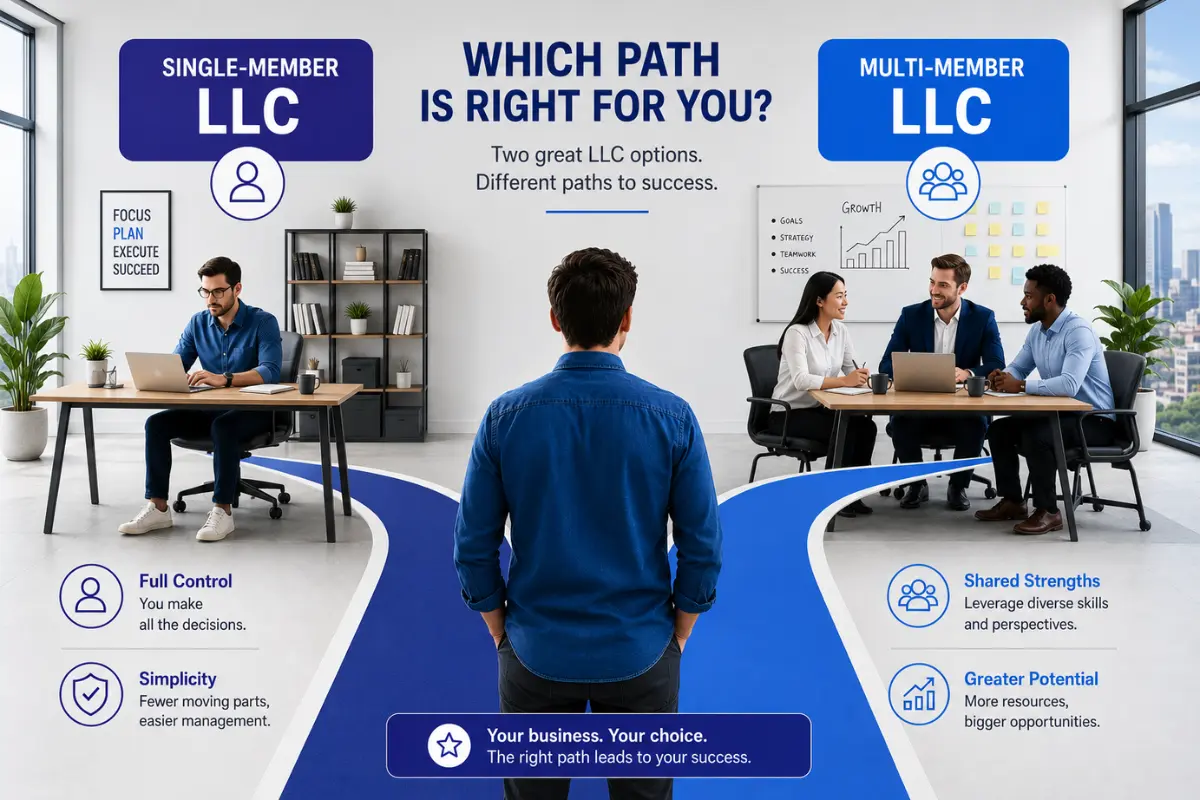
Single-Member LLC
Multi-Member LLC
Single-Member LLC
Multi-Member LLC
Single-Member LLC
Multi-Member LLC
Single-Member LLC
Multi-Member LLC
Single-Member LLC
Multi-Member LLC
What Are the Disadvantages of a Single-Member LLC?
- Being your own boss has real perks. But running solo comes with a few tradeoffs worth knowing.
- One owner means every decision lands on your desk, with no partner to bounce ideas off of.
- Raising capital can be tougher. Lenders and investors often like seeing more than one owner backing a business.
- Succession planning takes extra thought, since the business doesn’t just keep running on its own without you.
- Self employment tax can eat into your bottom line unless you elect S Corporation status.
- You miss out on the collaboration that comes with having co-owners.
None of that makes a single-member LLC a bad choice. For a lot of solo owners, the tradeoffs are a fair price for the control that comes with running the show yourself.
Single Member LLC vs Multi Member LLC for Husband and Wife
Married couples running a business together face a question most partners don’t: should your jointly owned LLC count as single-member or multi-member for tax purposes?
In community property states, spouses can sometimes treat a jointly owned LLC as a single-member LLC for federal tax purposes, even though you both own it. That can make filing noticeably simpler. Under IRS rules, if an LLC is owned solely by a married couple as community property and no one else is an owner for federal tax purposes, the IRS will accept that the LLC is treated as a disregarded entity unless the couple elects to be treated as a partnership.
Outside those states, the IRS does not allow the Qualified Joint Venture election for an LLC. Instead, your jointly owned LLC defaults to partnership taxation: Form 1065 and a Schedule K‑1 for each spouse. If you want different tax treatment, you’d need to elect to be taxed as a corporation.
Rules shift by state, so a quick chat with a tax professional before filing can save you a headache later.
Multi-Member LLC vs Partnership
On the tax side, these two look similar. Both default to pass through partnership taxation. The real difference is what happens if things go wrong. A general partnership leaves your personal assets exposed to business debts and lawsuits. A multi-member LLC puts up a legal wall between the two.
That’s a big reason so many business partners choose an LLC over a general partnership. A bit of extra paperwork is a small trade for real protection.
Single-Member LLC vs Sole Proprietorship
At tax time, these two can look almost identical, since both typically use Schedule C. The real gap shows up if a client or vendor ever comes after your business for money. A sole proprietorship leaves you fully exposed. A single-member LLC puts a separate legal entity between you and that risk.
Want the full side-by-side? Check out our guide on LLC vs sole proprietorship before you make the call.
Do I Need an EIN for a Single-Member LLC?
Not always, but plenty of single-member LLC owners end up needing one anyway. Think of an EIN as a Social Security number for your business, issued by the IRS.
According to the IRS, “A single-member LLC that is a disregarded entity that does not have employees and does not have an excise tax liability does not need an EIN.”
Here’s where an EIN usually becomes necessary, or at least a lot more convenient:
- Hiring employees, which requires an EIN for payroll tax reporting
- Opening a business bank account, since most banks ask for one
- Electing S Corporation taxation, which requires an EIN
- Working with lenders or vendors who need a taxpayer identification number
Even when it’s not required, getting an EIN is usually smart. It keeps your business finances separate from your personal ones, which backs up the liability protection your LLC is there to give you.
Can You Change a Single-Member LLC into a Multi-Member LLC?
Yes, and it happens all the time as businesses grow. Bring on a new owner, and your single-member LLC becomes a multi-member LLC. A few things need to happen first.
- Adding another owner, starting with an agreement on ownership percentage and buy-in amount
- Updating the operating agreement to reflect new members, voting rights, and profit allocations
- Adjusting ownership percentages for everyone involved, not just the new member
- Filing IRS tax classification changes, since the LLC now defaults to partnership taxation
- Updating your state filings to reflect the new ownership structure
This shift touches both your taxes and your legal paperwork, so it’s a good moment to loop in a professional who can make sure everything gets filed correctly.
How to Choose Between a Single-Member and Multi-Member LLC
Still torn? Run through this quick checklist and see which side you land on.
Choose a Single-Member LLC if:
- You are the only owner
- You want complete control over business decisions
- You prefer simpler tax filing
- You don’t expect to add partners soon
Choose a Multi-Member LLC if:
- You have one or more business partners
- You’ll share startup costs and investments
- You want additional expertise
- You expect the business to grow with multiple owners
Once you know which way you’re leaning, it helps to know what forming an LLC actually costs. Our breakdown of the cost to start an LLC walks through state filing fees and other expenses to expect.
Conclusion
Both a single-member LLC and a multi-member LLC give you real liability protection. The real differences come down to ownership and taxes: one owner filing a simple return, or multiple owners splitting profits and a more involved tax process.
Think about where your business stands today and where you want it to go. Getting the structure right from the start saves you hassle down the road.
Want to see what the timeline looks like? Check out our guide on how long it takes to form an LLC.
Let Us Handle the Paperwork
Forming an LLC involves more than paperwork. It means navigating state-specific requirements, deadlines, and details that are easy to overlook. We simplify the process: share some basic information about your business, and we take care of the filing. We can also serve as your registered agent in any state, so you never miss an important legal notice.
Our involvement doesn’t end once your LLC is formed. We provide ongoing support with annual reports, operating agreement updates, and amendments, helping your business stay in good standing over time. Contact us today, and we’ll help you get started.
FAQs
Neither one wins across the board. A single-member LLC suits solo owners who want control and simplicity. A multi-member LLC suits partners who want to share investment, workload, and expertise. It really comes down to how many owners you have.
In some community property states, yes. In other states, married co-owners typically file as a multi-member LLC or use the Qualified Joint Venture election instead.
Not necessarily. Profits and losses pass through to each member's personal tax return based on ownership share, so the total tax bill depends on each person's own situation, not the LLC structure itself.
Yes. A single-member LLC can become a multi-member LLC by adding an owner, updating the operating agreement, and filing the right changes with the IRS and your state.
No. One with no employees and no excise tax liability isn't required to have one, though many owners get one anyway to open a business bank account or elect S Corporation taxation.
Yes, unless the LLC elects S Corporation or C Corporation taxation instead.
It depends on ownership. Solo owners often prefer a single-member LLC for its simplicity, while small businesses with partners typically choose a multi-member LLC to formally share profits and responsibilities.
Disclaimer: This content is intended for general educational and informational purposes only and does not constitute legal, tax, or accounting advice. Every effort is made to keep the information current and accurate; however, laws, regulations, and guidance can change, and no representation or warranty is given that the content is complete, up to date, or suitable for any particular situation. You should not rely on this material as a substitute for advice from a qualified professional who can consider your specific facts and objectives before you make decisions or take action.