

How to Get an EIN Number (Step-by-Step Guide for 2026)
If you’re starting a business, you’ve probably come across the term EIN and wondered what it is and whether you actually need one. The short answer? Most businesses do, and getting one is easier than you might think.
Whether you’re forming an LLC, hiring your first employee, or just trying to open a business bank account, your EIN is one of the first things you’ll need to take care of. Think of it as your business’s Social Security number, a unique identifier the IRS uses to track your business for tax purposes.
In this DoMyLLC step-by-step guide, we’ll walk you through exactly how to get an EIN number, who needs one, and how to avoid the most common mistakes that can slow down the process.
Key Takeaways
- An EIN (Employer Identification Number) is your business’s federal tax ID, issued by the IRS.
- Most LLCs, corporations, partnerships, and businesses with employees need one.
- The fastest way to get an EIN is online through the IRS, and you’ll receive it immediately.
- Errors in your application can cause banking delays or require you to start over.
- DoMyLLC can handle your EIN filing as part of your business formation package.
What Is an EIN Number?
An EIN stands for Employer Identification Number. It’s also called a Federal Employer Identification Number (FEIN) or a federal tax ID number, and yes, they all refer to the exact same thing. So if someone asks whether an EIN is the same as a FEIN, the answer is yes.
The IRS defines it simply: an EIN is also known as a Federal Tax Identification Number, and it’s used to identify a business entity. An EIN is issued by the Internal Revenue Service (IRS) and generally remains tied to your business for its lifetime unless the structure changes significantly. Once issued, you use it to file taxes, run payroll, open a business bank account, and apply for business licenses and permits.
The U.S. Chamber of Commerce notes that an EIN establishes your business as a federally recognized tax entity, allowing you to perform essential activities like filing taxes and hiring employees.
Who Needs an EIN?
More businesses need an EIN than you might think, and in many cases, you’ll need one before you can even get your business fully off the ground. The U.S. Small Business Administration is clear on this: your EIN is your business’s federal tax ID, and you’ll need it to pay federal taxes, hire employees, open a business bank account, and apply for licenses and permits.
Here’s a quick breakdown of who typically needs one:
- LLCs: Whether you’re a single-member or multi-member LLC, getting an EIN for your LLC is almost always the right move, especially if you want to open a business bank account or hire employees.
- Corporations: All corporations are required to have one.
- Partnerships: Any business with two or more owners operating as a partnership needs an EIN.
- Businesses with employees: If you’re paying wages, you need an EIN for payroll purposes.
- Sole proprietors: You may not technically be required to have one, but it’s still a smart idea. It protects your personal Social Security number and makes it easier to build business credit.
Even if you’re a solo freelancer or independent contractor, knowing how to get a business tax ID can add a layer of professionalism and protection to how you operate.
Step-by-Step EIN Application Process
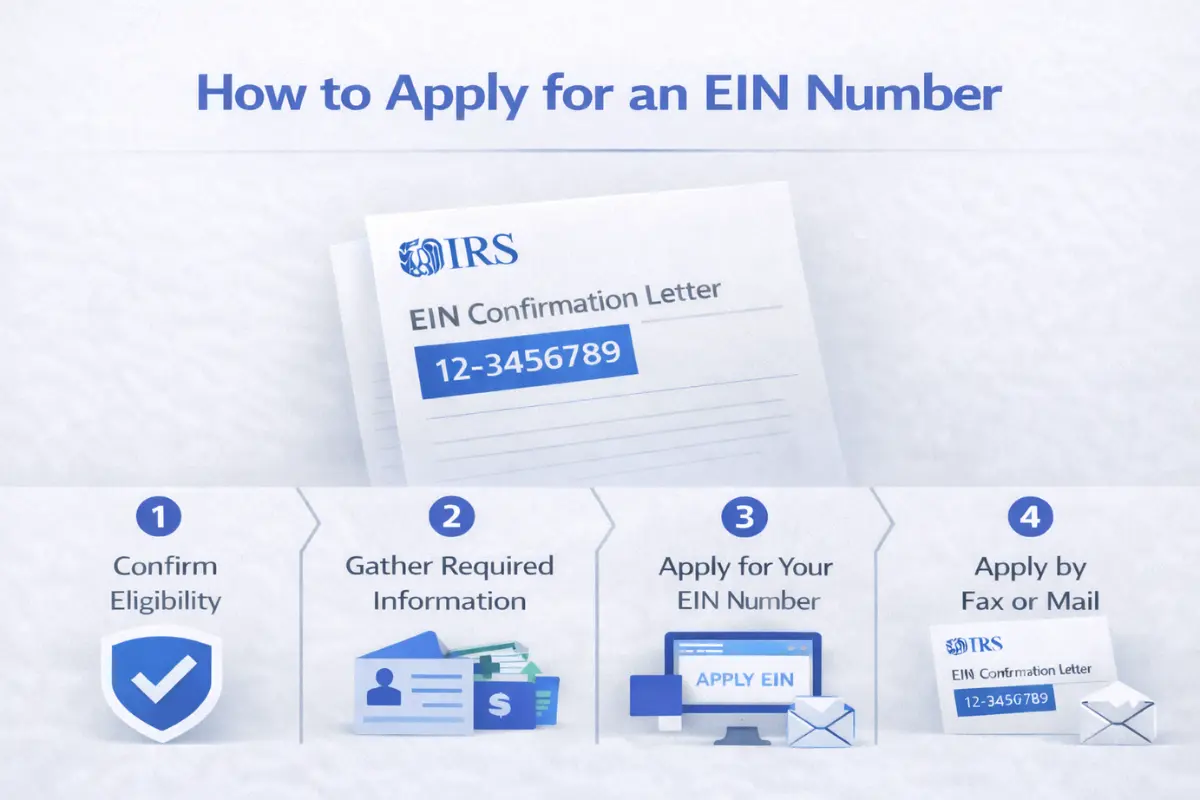
Step 1 – Confirm Eligibility
Before you apply, make sure your business is located in the United States or a U.S. territory. You’ll also need a responsible party, someone with a valid Taxpayer Identification Number (either a Social Security Number or an existing EIN) who can be held accountable for the business.
Step 2 – Gather Required Information
Have the following ready before you start the application:
- Your legal business name (exactly as it appears in your state registration)
- The responsible party’s Social Security Number
- Your business structure (LLC, corporation, sole proprietor, etc.)
- The reason you’re applying
Before applying, make sure your business entity is properly formed and your legal name matches your state registration. Applying with incorrect or incomplete formation details can create unnecessary complications.
Step 3 – Apply for Your EIN Number Online
The fastest way to apply for an EIN number is online through the IRS EIN portal. It takes about 15 minutes, and you’ll receive your EIN immediately upon completing the application. This is the most popular method for a reason, with no waiting and no paperwork to mail.
While many business owners apply for an EIN number online themselves, incorrect entity classification or mismatched information can lead to processing issues, rejected bank account applications, or the need to cancel and reapply.
Many business owners choose to work with a professional filing service like DoMyLLC to ensure their EIN application aligns correctly with their business formation and tax structure.
Step 4 – Apply by Fax or Mail
If online isn’t an option, you can submit IRS Form SS-4 by fax or mail. Fax processing takes around 4 business days; mail takes up to 4 weeks.
Although you can obtain an EIN directly online, many business owners choose to work with a professional filing service to ensure accuracy, avoid delays, and confirm their business structure is set up correctly from the start. When your EIN is tied to business formation, payroll setup, or tax elections, getting it right the first time matters.
How Long Does It Take to Get an EIN?
- Online: Immediate — you’ll get your EIN the same day
- Fax: Around 4 business days
- Mail: Around 4 weeks
The method you choose depends on your situation, but no matter how you apply, accuracy matters more than speed. Mistakes on your EIN application can cause delays with your bank account, payroll setup, or tax filings, which is why many business owners find it’s worth working with a professional filing service to make sure everything is done right the first time.
How to Get a Tax ID Number for a Business: LLC vs. Sole Proprietor
The process to get an employer identification number is the same regardless of your business type, but the requirements differ.
For an LLC, getting an EIN is essentially nonnegotiable. You’ll need it to open a business bank account, pay employees, and file your taxes properly. Even single-member LLCs, which the IRS treats as disregarded entities by default, benefit from having a separate EIN. It reinforces the legal separation between you and your business, which is a big part of why you formed an LLC in the first place.
For sole proprietors, an EIN is optional unless you have employees or file certain business tax returns. Many sole proprietors use their Social Security Number instead. But if you want to avoid sharing your SSN with clients or vendors, applying for a business tax ID number is a smart, easy fix.
Common Mistakes to Avoid When Getting an EIN
- Applying more than once: The IRS limits you to one EIN per day, and applying multiple times can create confusion in their system. If you made a mistake, contact the IRS to correct it rather than reapplying.
- Entering the wrong business name: Your EIN application must match your state registration exactly. Even small discrepancies can cause issues when opening a bank account.
- Choosing the wrong entity type: An LLC and a sole proprietorship are taxed differently. Selecting the wrong classification at this stage can affect your tax filings going forward.
- Confusing your EIN with a state employer ID: These are separate numbers. Some states issue their own employer ID for state tax purposes, which is different from your federal EIN.
In some situations, such as a simple business name change, you may not need a new EIN. Applying unnecessarily can create confusion with the IRS.
Need Help Getting an EIN?
Getting an EIN doesn’t have to be something you figure out on your own. Whether you need just an EIN or want to bundle it with full LLC formation, DoMyLLC has you covered.
Our team can handle your EIN filing as a standalone service or as part of a complete formation package, whichever fits where you are in your business journey. Either way, we make sure your application is submitted correctly so you can open a business bank account, hire employees, and stay compliant without delays.
Ready to get started? Contact us today and we’ll take care of the details so you can focus on building your business.
Conclusion
Getting an EIN number isn’t complicated, but it is important. It’s one of the first real steps in making your business official, and getting it right from the start saves you from headaches later. Whether you apply online yourself or let us handle it as part of your formation package, the key is making sure your information is accurate and your business structure is properly set up before you submit.
FAQ's
Yes. EIN and FEIN (Federal Employer Identification Number) are two names for the same thing. Both refer to the nine-digit number the IRS assigns to your business.
In most cases, yes. If your LLC has more than one member, has employees, or you want to open a business bank account, you'll need an EIN for your LLC. Even single-member LLCs benefit from having one.
Yes. You can apply for an EIN as a sole proprietor without forming a formal business entity. However, if you plan to form an LLC, it's best to do so first so your EIN reflects your correct business structure.
Sometimes. If you already have an EIN from a previous business, you may be able to reuse it depending on the situation. Major structural changes, like converting from a sole proprietorship to an LLC, typically require a new EIN.
Your EIN is on the IRS confirmation notice you received when you first applied. You can also find it on previous tax returns, bank account documents, or business licenses.
Yes, often. Your federal EIN covers federal taxes, but many states also require a state tax ID for state income, sales, or payroll taxes. Requirements vary, so check with your state's revenue department to see what applies to your business.
Usually, yes. An EIN serves as your business's federal tax ID number and is used by the IRS for taxes, payroll, and licenses. However, "tax ID" can also mean a Social Security Number for sole proprietors or a state tax ID for state filings. In most cases, when asked for your business tax ID, they mean your EIN.
Yes. Non‑U.S. residents and foreign businesses can get an EIN if they need to file taxes or do business in the U.S. The online application is only for businesses based in the U.S. or its territories, so foreign applicants must apply by fax, mail, or phone using IRS Form SS‑4.
Disclaimer: This content is intended for general educational and informational purposes only and does not constitute legal, tax, or accounting advice. Every effort is made to keep the information current and accurate; however, laws, regulations, and guidance can change, and no representation or warranty is given that the content is complete, up to date, or suitable for any particular situation. You should not rely on this material as a substitute for advice from a qualified professional who can consider your specific facts and objectives before you make decisions or take action.