

What Is Administrative Dissolution? Meaning, Causes, and How to Fix It
A deadline slips. A notice gets missed. Then one day you find out the state has administratively dissolved your LLC, not because you chose to close, but because certain compliance requirements went unmet. It’s more common than you’d think, and the consequences are real: lost liability protection, restricted business operations, and potential personal exposure.
The good news is that it’s fixable in most cases. This guide covers what administrative dissolution means, why it happens, and how to get your business back in good standing. If you’d rather not navigate it alone, DoMyLLC offers reinstatement and compliance services to make the process straightforward.

What Is Administrative Dissolution?
Administrative dissolution is when a state government officially removes a business’s active status due to noncompliance with state requirements. Unlike closing a business voluntarily, administrative dissolution is something that happens to you, not something you choose. The state initiates it, and it applies to LLCs and corporations alike.
Think of it like a driver’s license suspension. You didn’t choose to lose your driving privileges, but you missed enough requirements that the state revoked them. Your car is still in the driveway, but legally, you can’t drive it. Your business works the same way after dissolution. The entity still exists on paper, but its legal standing to operate has been pulled.
For example, imagine a freelance designer who formed an LLC years ago but never kept up with annual reports. One day she goes to sign a contract with a major client and discovers her LLC shows as “dissolved” in the state’s business registry. She didn’t close her business. The state did it for her.
State agencies, such as the California Secretary of State, maintain records of business entities and can suspend or dissolve businesses that fail to meet state filing and compliance requirements.
Why Would an LLC Be Administratively Dissolved?
States require businesses to check in regularly. When they don’t, the state treats silence as abandonment. As the U.S. Small Business Administration explains, businesses must stay compliant with state requirements, including filing reports and maintaining registrations, to remain in good standing.
Most administrative dissolution cases come down to a handful of common oversights, often ones that sneak up on busy owners who are focused on running their business rather than managing paperwork.
Common Reasons for Administrative Dissolution
- Failure to file annual reports: Most states require LLCs to submit an annual or biennial report confirming basic business information. Missing the deadline, even by accident, can trigger dissolution proceedings.
- Failure to maintain a registered agent: Every LLC must have a registered agent on file who can receive official state correspondence. If your agent resigns or becomes invalid and you don’t replace them, the state may dissolve your LLC.
- Missed state fees or franchise taxes: Some states charge annual fees or franchise taxes just to keep your business active. Unpaid balances can quickly lead to dissolution.
- Ignoring state notices: States typically send warnings before dissolving a business. If those notices go to an old address or get lost in the shuffle, the dissolution may come as a complete surprise.
What Happens When an LLC Is Administratively Dissolved?
Administrative dissolution isn’t just a status change in a government database. It carries real, practical consequences that can affect your business operations, your finances, and even your personal liability.
According to the IRS, businesses that fail to meet ongoing legal and tax obligations may lose their legal status and must take corrective steps before resuming operations.
Here’s what you could be looking at after an administrative dissolution:
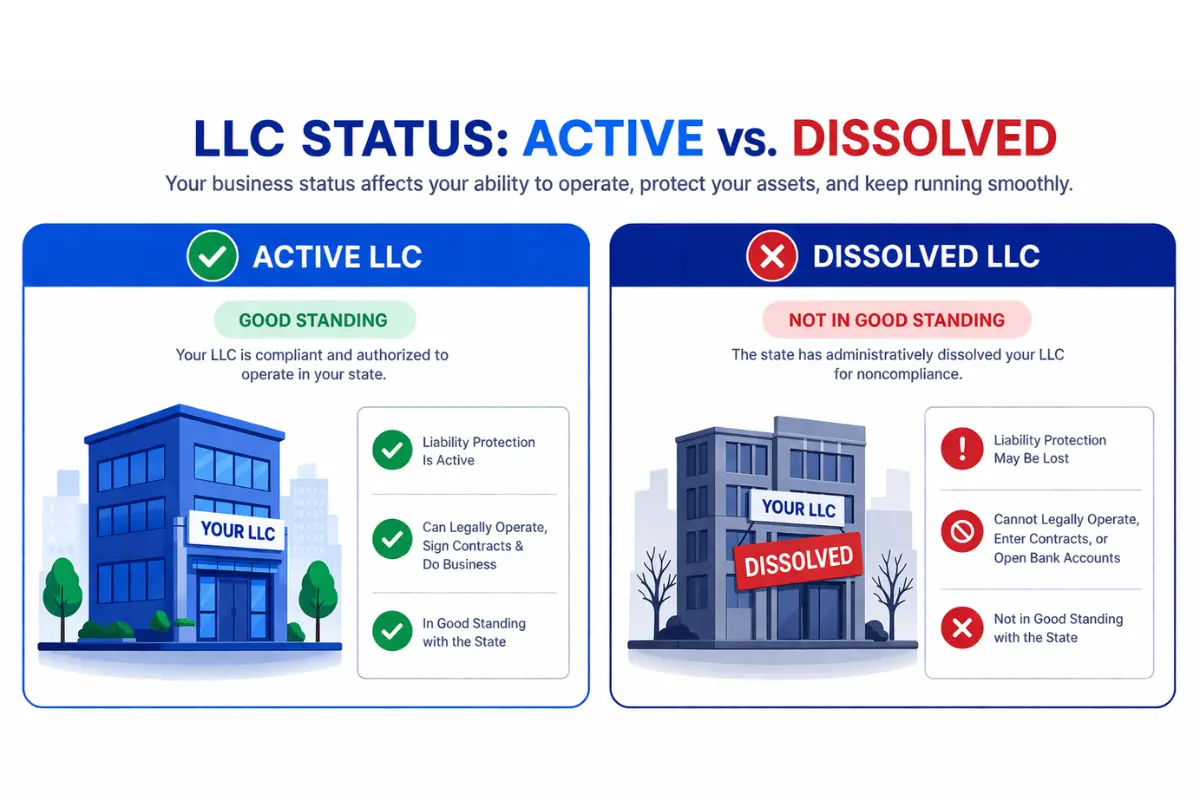
- Loss of good standing: Your business will show up as dissolved or not in good standing in public records. That’s often the first thing lenders, clients, and partners check before doing business with you.
- Risk to limited liability protection: One of the main reasons to form an LLC is to separate your personal assets from your business debts. After dissolution, that protection may be weakened or lost entirely. If someone sues your dissolved LLC, you could be personally on the hook.
- Inability to legally operate: Depending on your state, a dissolved LLC may be prohibited from entering contracts, initiating lawsuits, or conducting business at all.
- Possible loss of your business name: Once dissolved, another business may be able to register your exact business name in your state. That name you’ve spent years building? Gone.
- Issues with banking, contracts, and credibility: Banks may freeze accounts, refuse new accounts, or flag transactions for a dissolved entity. Existing contracts could be called into question, and clients may lose confidence in your business.
Can Administrative Dissolution Be Reversed?
Yes, in most cases, administrative dissolution can be reversed through a process called reinstatement. This is one of the most important things to understand if your LLC has been dissolved: it doesn’t have to be the end.
That said, reinstatement is not automatic, and it is not unlimited. Most states have a window of time, sometimes a few years, during which a dissolved business can apply for reinstatement. After that window closes, the business may be permanently dissolved and you would need to form a new entity from scratch.
Every state handles this differently. Some states have a straightforward reinstatement process with minimal fees. Others stack on penalties, require multiple filings, and make you catch up on every missed report before they’ll restore your status. The clock starts ticking from the moment of dissolution, so acting quickly matters.
How to Reinstate a Business After Administrative Dissolution
Reinstatement is not as complicated as it sounds, but it does require some legwork. Here’s a step-by-step look at how to reinstate a dissolved LLC in most states.
Step-by-Step Reinstatement Process
Step 1: Determine the Cause of Dissolution
Start by contacting your state’s business filing office or checking your state’s online business registry. Find out exactly why your LLC was dissolved. Was it a missed annual report? An unpaid fee? A lapsed registered agent? You need to know the root cause before you can fix it.
Step 2: Complete Any Missing Filings
If you have outstanding annual reports or other required state filings, you’ll need to catch up on all of them, not just the most recent one. Some states require you to file every missing report from the date of dissolution forward.
Step 3: Pay Outstanding Fees and Penalties
Most states will charge late fees or penalties in addition to the standard filing fees you missed. These can add up quickly, especially if your business has been dissolved for a long time. Budget for this before you begin.
Step 4: Submit a Reinstatement Application
Once your filings are complete and your balance is cleared, you can file a formal application for reinstatement with your state. This is sometimes called an Application for Reinstatement or a Certificate of Reinstatement, depending on the state.
Timelines vary widely by state. Some states process reinstatements within a few business days. Others take several weeks. If you need your business reinstated quickly, some states offer expedited processing for an additional fee.
For a deeper look at the full reinstatement process, check out our guide on how to reinstate a dissolved LLC.
How to Avoid Administrative Dissolution in the Future
Once you’ve gone through the reinstatement process, the last thing you want is to end up back in the same situation. A little proactive attention goes a long way when it comes to staying compliant.
- File annual reports on time. Mark your filing deadlines on your calendar well in advance. Most states send reminders, but don’t count on that alone. Know your deadlines and treat them like taxes: non-negotiable.
- Keep your registered agent active. Make sure your registered agent information is always current with the state. If your agent changes, update the state immediately. A lapsed or inactive registered agent is one of the most common causes of administrative dissolution.
- Track compliance requirements and deadlines. Between annual reports, franchise taxes, state fees, and registered agent renewals, there’s a lot to juggle. Use a compliance calendar or partner with a service that tracks these deadlines for you.
- Monitor state notices. States typically send warnings before dissolving a business. Make sure your registered address and registered agent address are always up to date so these notices actually reach you. One missed letter can spiral into a dissolved LLC.
Administrative vs. Voluntary Dissolution: What’s the Difference?
It’s easy to confuse administrative dissolution with voluntary dissolution, but they are fundamentally different situations. Understanding the difference between administrative and voluntary dissolution of an LLC can help you know what you’re dealing with and what your options are.
| Administrative Dissolution | Voluntary Dissolution |
| Initiated by the state | Initiated by the owner |
| Caused by noncompliance | Planned business closure |
| May include penalties | Typically no penalties |
| Often requires reinstatement | Final and intentional |
Voluntary dissolution is a deliberate, owner-initiated process. You decide to close the business, you file the appropriate paperwork with the state, and you wind down operations on your own terms. It’s orderly and intentional, and it typically wraps up any loose ends in a clean, legally recognized way.
Administrative dissolution, on the other hand, catches most business owners off guard. It’s imposed by the state, comes with potential penalties, and requires active steps to undo. If your goal is to actually continue operating your business, voluntary dissolution is not an option; reinstatement is the path forward.
Final Thoughts
Administrative dissolution happens quietly, until suddenly it doesn’t. It’s serious, but it’s fixable in most cases as long as you act before your state’s reinstatement window closes.
The bottom line: stay compliant. File your annual reports, keep your registered agent active, and don’t ignore state notices. Those aren’t optional steps. They’re what keeps your LLC protected and in good standing.
Need Help Getting Your Business Back in Good Standing?
Whether your LLC has been administratively dissolved or you just want to stay ahead of compliance, we handle the paperwork, deadlines, and reinstatement so you don’t have to. Contact us today and let’s get your business back in good standing.
Frequently Asked Questions
It means the state has revoked your LLC's active status due to noncompliance. Your business name may still exist in state records, but you lose the legal protections and operating rights that come with an active LLC, including limited liability protection. You'll need to go through reinstatement to restore your business.
Yes, it's a serious problem. It means your LLC has lost its good standing with the state, your personal assets may no longer be protected from business liabilities, and you may be legally prohibited from conducting business in your state. The sooner you address it, the better your options.
It depends on your state. Some states process reinstatements in as little as a few business days, while others can take several weeks. Expedited processing is available in many states for an additional fee. The timeline also depends on how quickly you can gather and file any missing reports or pay outstanding fees.
Not necessarily. Once your LLC is dissolved, your business name may become available for other businesses to register in your state. The longer you wait to reinstate, the higher the risk that someone else claims your name. Acting quickly gives you the best chance of preserving it.
When an LLC is administratively dissolved, existing contracts remain in effect, but the business may lose the legal right to enforce or create new ones. Debts incurred before dissolution still stand, and creditors can pursue payment. If the LLC continues operating while dissolved, members could be personally liable for new debts since limited liability protection may no longer apply. Addressing dissolution quickly helps avoid these risks.
Yes. Banks and lenders usually check your LLC's good standing before opening or maintaining accounts. If your business is administratively dissolved, they may freeze accounts, refuse new ones, or suspend services. Some payment processors do the same. Reinstating your LLC and restoring good standing will resolve the issue, but until then, your business operations may be disrupted.
Administrative dissolution is carried out by a state agency, typically the Secretary of State or a similar filing office, when a business entity fails to meet compliance requirements like filing annual reports, paying franchise taxes or privilege taxes, or maintaining a registered agent. Judicial dissolution, by contrast, is ordered by a court. It usually happens in more serious situations, such as when members of an LLC cannot resolve internal disputes, when a sole shareholder seeks to wind down operations through the courts, or when a state takes legal action against a company for fraud or abuse. Administrative dissolution is far more common and is generally reversible through reinstatement. Judicial dissolution is typically final and involves formally dissolving the entity, liquidating assets, paying debts, and distributing remaining assets to members or shareholders.
In many states, yes. You typically have 60 to 90 days after receiving notice to fix compliance issues before your LLC is administratively dissolved. Even after dissolution, most states allow a limited reinstatement period so you can restore the business without starting over. Once that window closes, you'll need to form a new entity. Since rules vary, check with your Secretary of State's office promptly. Staying current on filings is much easier and cheaper than reinstating later.
Yes. If your LLC is dissolved and you keep doing business under its name, you can lose your personal liability protection. Members who sign contracts, take on debt, or make decisions for a dissolved LLC may be personally responsible for those obligations as if the LLC didn't exist. This puts your personal assets, such as bank accounts and property, at risk. To protect yourself, either reinstate your LLC or formally dissolve it if you're done operating.
Disclaimer: This content is intended for general educational and informational purposes only and does not constitute legal, tax, or accounting advice. Every effort is made to keep the information current and accurate; however, laws, regulations, and guidance can change, and no representation or warranty is given that the content is complete, up to date, or suitable for any particular situation. You should not rely on this material as a substitute for advice from a qualified professional who can consider your specific facts and objectives before you make decisions or take action.