

How to Reinstate a Dissolved LLC (Step-by-Step Guide for 2026)
One missed deadline. One overlooked fee. That’s often all it takes for a state to dissolve your LLC, sometimes without much notice. If that’s where you find yourself, the good news is that most states allow you to reinstate a dissolved LLC and pick up where you left off, without forming a brand new business.
This guide covers everything you need to know, from the required documents and fees to the common mistakes that slow things down. DoMyLLC helps take the guesswork out of the reinstatement process, making sure everything is filed correctly and on time.
Key Takeaways
- Most dissolved LLCs can be reinstated if you act within your state’s reinstatement window.
- Administrative dissolution usually happens when annual reports or fees are missed.
- You must resolve the underlying compliance issues before reinstatement is approved.
- Costs and timelines vary significantly by state, and some can take days while others take weeks.
- Missing documents and incomplete filings are the most common causes of delays.
What Happens When an LLC Is Administratively Dissolved?
Administrative dissolution is one of the most common situations business owners face, often without realizing it until something goes wrong.
According to the U.S. Small Business Administration, businesses can be administratively dissolved when they fail to meet state requirements like filing annual reports or paying required fees. It’s not usually the result of one dramatic event. It’s a quiet process that happens in the background when compliance deadlines are missed.
Common reasons an LLC gets dissolved include:
- Failing to file annual reports on time
- Unpaid state fees or franchise taxes
- An outdated or missing registered agent
- Failure to respond to state notices
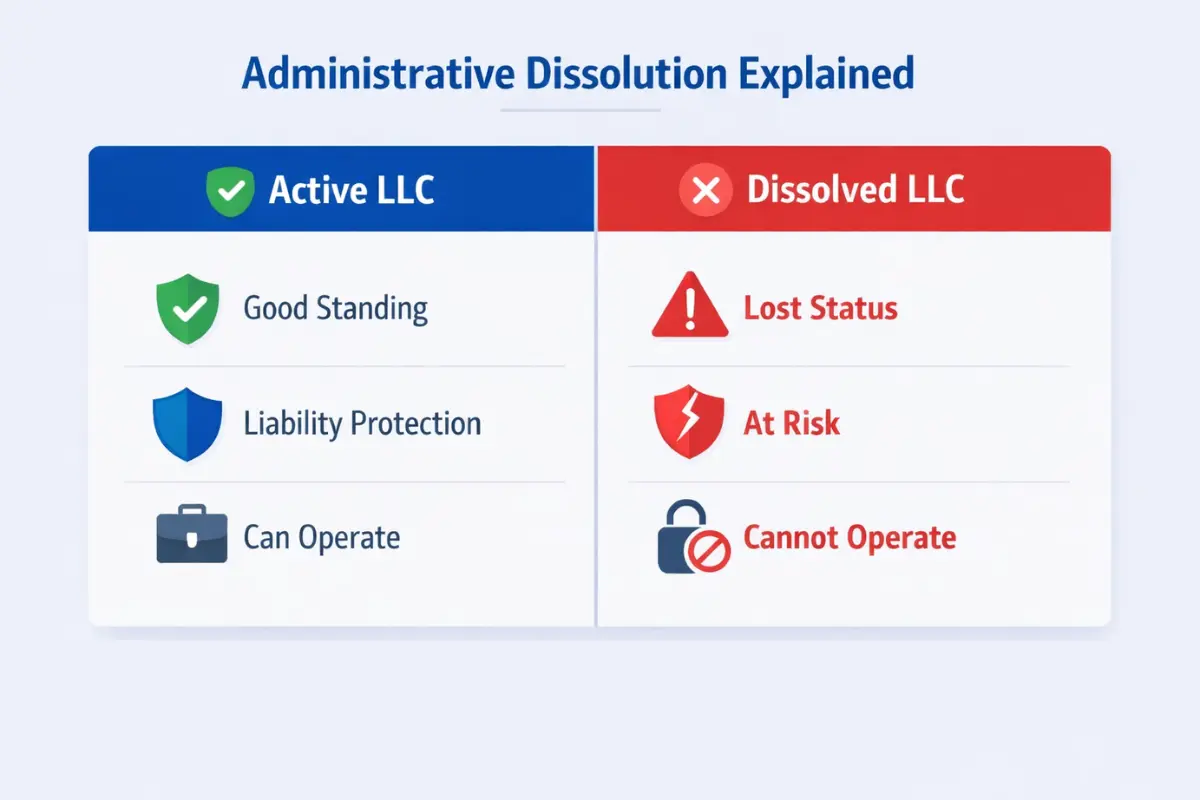
Once dissolution happens, the consequences are significant. Your LLC loses its good standing status, which means it cannot legally conduct new business, enter into enforceable contracts, or maintain banking relationships as a business entity.
Perhaps most importantly, the liability protection that made your LLC valuable in the first place may be at risk for debts incurred after the dissolution date, potentially exposing members to personal liability. The LLC itself continues to exist solely to wind up affairs and liquidate assets.
The Internal Revenue Service emphasizes that businesses must stay compliant with ongoing filing and tax requirements to maintain their legal status and avoid penalties. The sooner you address it, the better.
Can a Dissolved LLC Be Reinstated?
In most states, yes. You can reinstate a dissolved LLC. But there are conditions, and the window to do so doesn’t stay open forever in many states.
Generally, reinstatement is available when:
- Your LLC was administratively dissolved (voluntarily dissolved LLCs usually cannot be reinstated, though a few states allow revocation within 120 days to 1 year)
- You’re within the state’s reinstatement window (which ranges from 1 to 5 years in most states, though some states like Delaware, Wyoming, and Nevada have no time limit)
- You’re able to bring the business back into full compliance by filing delinquent reports, paying owed taxes and fees, and submitting a reinstatement application
Every state handles this differently. Some have a generous reinstatement period or no deadline at all. Others give you a narrow window before the entity is gone for good. If your window has closed, forming a new LLC may be your only option rather than reviving the old one, and you could lose your original business name in the process.
How to Reinstate a Dissolved LLC (Step-by-Step)
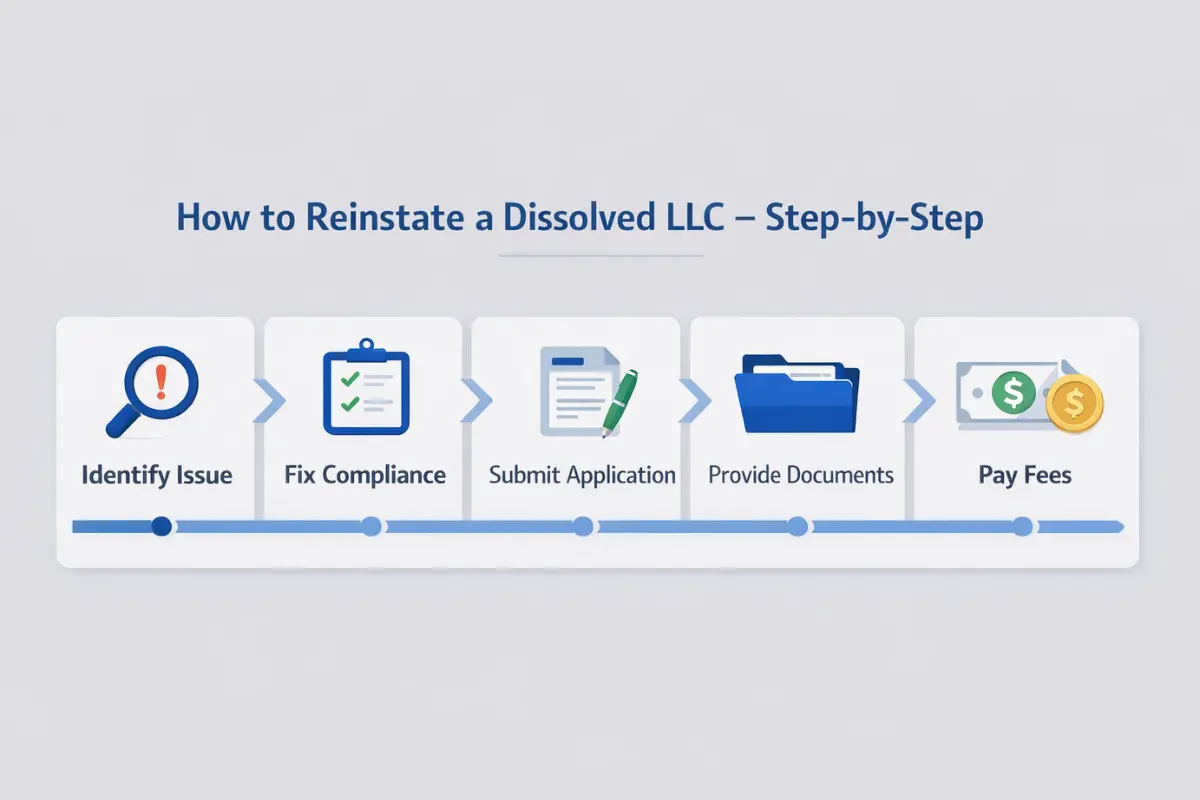
The process to reinstate a dissolved LLC follows a similar pattern in most states, though the forms and fees will vary. Here’s what that process typically looks like.
Step 1: Identify the Reason for Dissolution
Before you can fix the problem, you need to know what caused it. Log into your state’s Secretary of State website or business filing portal and look up your LLC’s current status. The record should indicate why the dissolution occurred, whether it was a missed annual report, unpaid fees, or a compliance failure. This is your starting point.
Step 2: Bring Your LLC into Compliance
This step is non-negotiable. The Texas Secretary of State reinstatement FAQs explain that before your LLC can usually be reinstated, you will need to correct the problems that caused the dissolution in the first place, and reinstatement generally requires filing delinquent reports and paying any fees, taxes, penalties, and interest that are due. That’s true in Texas and in most other states too.
This typically means:
- Filing all missing or overdue annual reports
- Paying all outstanding fees and penalties
- Updating registered agent information if it had lapsed
- Obtaining a tax clearance certificate in states that require one (about 15 to 20 states)
Step 3: Complete the Reinstatement Application
Once your compliance issues are resolved, you’ll complete your state’s official reinstatement application, sometimes called an Application for Reinstatement or a Certificate of Reinstatement. This form typically asks for your LLC’s name, state filing number, reason for dissolution, and confirmation that compliance issues have been resolved. In some states, you must obtain tax clearance before submitting this form.
Step 4: Submit Required Documents
Along with the application, submit any supporting documents your state requires, including filed annual reports, proof of tax clearance, or updated registered agent information. Submit everything together. Incomplete filings are one of the top reasons reinstatement requests are rejected or delayed.
Step 5: Pay Reinstatement Fees
Almost every state charges a reinstatement fee on top of any back fees or penalties you’ve already paid. These are separate, so make sure you’ve accounted for both. Once payment is received and your filing is approved, your LLC’s status will be restored. Processing times vary from same-day approval in some states to several weeks in others.
What Documents Are Needed to Reinstate an LLC?
Knowing what documents are needed to reinstate an LLC ahead of time saves a lot of back-and-forth. While requirements vary by state, most reinstatement filings will require some combination of:
- Application for reinstatement: the official state form for reviving your LLC (sometimes called Articles of Reinstatement or Certificate of Revival)
- Past due annual reports: any reports you missed that led to dissolution (though a few states only require the most recent 1–2 reports)
- Tax clearance certificate: required in some states to confirm you don’t have outstanding tax liabilities
- Updated registered agent information: if your agent’s information is outdated or the agent has resigned
- Payment: covers all accumulated fees, penalties, and the reinstatement fee itself
Some states may also require supporting documents like affidavits, proof of payment, or copies of tax returns. Some states have a very streamlined process. Others require multiple documents submitted to multiple agencies. Always confirm requirements on your state’s official Secretary of State website before filing.
How Much Does It Cost to Reinstate an LLC?
The cost to reinstate an LLC varies widely depending on the state and how long the LLC has been dissolved. As a general range, state reinstatement fees typically fall somewhere between $25 and $750. But that’s just the base fee.
On top of the reinstatement fee, you may also owe:
- Overdue annual report fees (per year missed)
- Late penalties assessed by the state
- Unpaid franchise taxes (in states that charge them, like California and Delaware)
- Tax clearance fees (if required)
- Expedited processing fees (optional, but available in many states)
In some states, the total cost can run into the hundreds or over a thousand dollars if multiple years of reports, taxes, and fees are outstanding. Getting reinstated sooner almost always costs less.
How Long Does It Take to Reinstate an LLC?
How long it takes to reinstate an LLC depends on two main factors: how quickly your state processes the filing and how complete your submission is when it arrives.
Typical processing times range from a few business days to several weeks, though a few states can take several months without expedited service. Many states process online filings faster than paper submissions.
Some states offer expedited processing for an additional fee, which can cut the timeline down to 1–5 business days if you need to be back in business fast. Others process at a set pace with no rush option available.
The biggest variable is the completeness of your filing. States that receive an incomplete reinstatement application will reject it or send it back, adding days or weeks to the process. Submitting everything correctly the first time, preferably online if your state offers it, is the single most effective way to speed things up.
A professional service like DoMyLLC can help make sure your filing is complete and accurate from the start, so you’re not losing days or weeks to an avoidable rejection.
How to Restore a Dissolved LLC to Good Standing
Reinstating your LLC and restoring it to good standing are closely linked: reinstatement is the process, and good standing is the result. Good standing means your LLC is recognized by the state as a legally operating entity, compliant with all filing and payment requirements, authorized to do business, and protected under the structure you originally formed.
Once reinstated, keeping your LLC in good standing is the next job. That means staying on top of annual reports, paying any required fees on time, and maintaining a registered agent on file so you never end up in this situation again. After approval, you may need to request a Certificate of Good Standing as proof for banks, lenders, or clients.
If your business operates in multiple states, be aware that you may need to reinstate in each state where you’re foreign qualified. For state-specific guidance, we’ve compiled detailed reinstatement guides for three common jurisdictions as examples: how to reinstate an LLC in Texas, how to reinstate an LLC in Florida, and how to reinstate an LLC in Georgia.
Common Mistakes That Delay LLC Reinstatement
Most reinstatement delays are preventable. Here are the mistakes we see most often:
- Missing documents: Submitting an application without all required attachments is a quick path to rejection. Check your state’s checklist before filing.
- Incorrect forms: Some states update their forms annually. Using an outdated form can get your filing sent back.
- Unpaid fees: If you haven’t cleared all back fees, penalties, and taxes before submitting the reinstatement application, expect problems.
- Filing with the wrong department: Depending on your state, reinstatement may need to go through the Secretary of State, the Department of Revenue, or both—and in some cases, tax clearance must be obtained first. Know where to file and in what order before you submit.
- Typos in entity details: Incorrect LLC names or filing numbers cause mismatches in state databases and trigger automatic returns.
Taking a few extra minutes to double-check everything before submitting can save weeks of back-and-forth.
Fastest Way to Reinstate a Dissolved LLC
If you want to get back in business as quickly as possible, here’s what matters most:
- File online through your state’s official business filing portal when available, as it’s significantly faster than paper submissions.
- Resolve all compliance issues first—file missing reports, pay owed taxes and penalties, and obtain tax clearance (if required) before submitting your reinstatement application.
- Double-check every document and fee before submitting. A rejected filing adds weeks to the process.
- Use expedited processing if your state offers it and time is a priority—this can cut approval times from weeks to 1–5 business days.
That said, knowing exactly what your state requires and getting it right the first time is where most business owners run into trouble. Using a professional filing service takes the guesswork out of it. When you file for LLC reinstatement after dissolution with expert help, your documents are reviewed for accuracy before they’re submitted, which significantly reduces the risk of rejection or delay.
It’s also worth understanding the difference between business reinstatement vs. renewal so you know exactly what you’re filing for.
Final Thoughts
A dissolved LLC doesn’t have to mean the end of your business. In most states, reinstatement is possible. It just requires resolving your compliance issues, filing the right documents, and paying the applicable fees. The process varies by state, but the principle is the same everywhere: fix what caused the dissolution, and your LLC can be restored.
The biggest factor in how quickly reinstatement succeeds is accuracy. An incomplete or incorrect filing can set you back weeks. Getting it right the first time is what separates a smooth reinstatement from a frustrating one.
Reinstate Your LLC and Get Back to Business Faster
Navigating the reinstatement process on your own is possible, but it’s easy to miss a step, use an outdated form, or overlook a required document. We handle the details so you don’t have to, making sure your filing is complete, accurate, and submitted to the right place the first time.
Ready to get your LLC back in good standing? Contact us today and we’ll take it from there.
FAQs
In most states, yes, but the window for reinstatement varies. Some states allow it for several years after dissolution; others have a much shorter timeframe. Check your state's Secretary of State website to confirm the reinstatement window and specific requirements where your LLC was formed.
Processing times vary by state, typically ranging from a few business days to several weeks. If your state offers expedited processing, that can speed things up for an additional fee. The most important factor in timeline is submitting a complete, accurate filing the first time.
State reinstatement fees generally range from $25 to $500, but the total cost will depend on how many years of back reports and penalties you owe. The longer an LLC has been dissolved, the higher the total cost tends to be.
If you don't reinstate your LLC, it will remain dissolved. That means you're no longer protected by the liability shield the LLC provided, you can't legally conduct business under that entity, and you may eventually lose the right to reinstate altogether. At that point, forming a new LLC would be your only option, which means starting over rather than picking up where you left off.
In most cases, yes. When you successfully reinstate a dissolved LLC rather than forming a new LLC, your business entity retains its original federal employer identification number (EIN), contracts, and business history. This is one of the biggest advantages of going through the reinstatement process instead of starting over. However, you should confirm with the IRS that your EIN is still active, especially if the LLC has been a dissolved business entity for an extended period. If you formed a new LLC instead, you would need to apply for a new EIN entirely.
Yes. Most states require a valid registered agent with a current office address on file before approving reinstatement. If your previous agent resigned or your address changed, you must update this information as part of the process. An active registered agent is an ongoing compliance requirement and will continue receiving official state correspondence and legal notices once your LLC is back in good standing.
Liability protection may not hold for debts incurred while your LLC was dissolved. If you conducted business during that window, you could be personally liable for those obligations since a dissolved entity isn't recognized as a valid LLC. Consulting a business attorney is recommended, especially if contracts were signed or disputes arose during that period.
Disclaimer: This content is intended for general educational and informational purposes only and does not constitute legal, tax, or accounting advice. Every effort is made to keep the information current and accurate; however, laws, regulations, and guidance can change, and no representation or warranty is given that the content is complete, up to date, or suitable for any particular situation. You should not rely on this material as a substitute for advice from a qualified professional who can consider your specific facts and objectives before you make decisions or take action.