

Start an LLC: Step-by-Step Guide to Form Your Business (2026)
Imagine you land your biggest client yet. Things are going great, until they are not. A dispute turns into a lawsuit, and suddenly your personal bank account is part of the conversation.
That is the reality for business owners who operate without an LLC. Your business problems become your personal problems, fast.
Starting an LLC creates the legal separation that keeps your personal finances protected, no matter what happens on the business side. It also builds the kind of credibility that makes clients, vendors, and partners take you seriously. Our team at DoMyLLC helps entrepreneurs get their LLC formed quickly and correctly. This guide walks you through every step.

Key Takeaways
- Starting an LLC protects your personal assets from business debts and lawsuits.
- The LLC formation process varies slightly by state, but the core steps are the same.
- How much it costs to start an LLC depends on your state filing fee and any services you use.
- You can start an LLC online, but working with a professional formation service reduces the risk of errors and delays.
- A registered agent is required in every state and must have a physical address where your LLC is formed.
- Staying compliant after formation is just as important as getting started.
What Does It Mean to Start an LLC?
An LLC, or Limited Liability Company, is a business structure that gives you the legal separation between yourself and your business. That separation is the key ingredient that protects your personal finances if things go sideways.
According to the U.S. Small Business Administration, an LLC is a business structure that combines the limited liability protection of a corporation with the simplicity and flexibility of a partnership or sole proprietorship.
People choose LLCs because they strike the right balance. You get serious legal protection without the heavy compliance burden of a full corporation. No required board meetings, no shareholder votes, and fewer formalities overall.
It makes sense to form an LLC when you are generating income, working with clients, or have personal assets worth protecting. If you are still weighing your options, our guide on the best business structure for entrepreneurs can help you decide.
How to Start an LLC (Step-by-Step Guide)
Here is the straightforward breakdown of how to start an LLC in any state. The steps are consistent, even if the fees and timelines vary.
Each of these steps can be done independently, but filing errors and missed requirements can slow things down or cause rejections. Working with a professional formation service like DoMyLLC takes the guesswork out of the process. We verify your information, handle the filing, and make sure everything is submitted correctly so you can focus on building your business, not chasing paperwork.
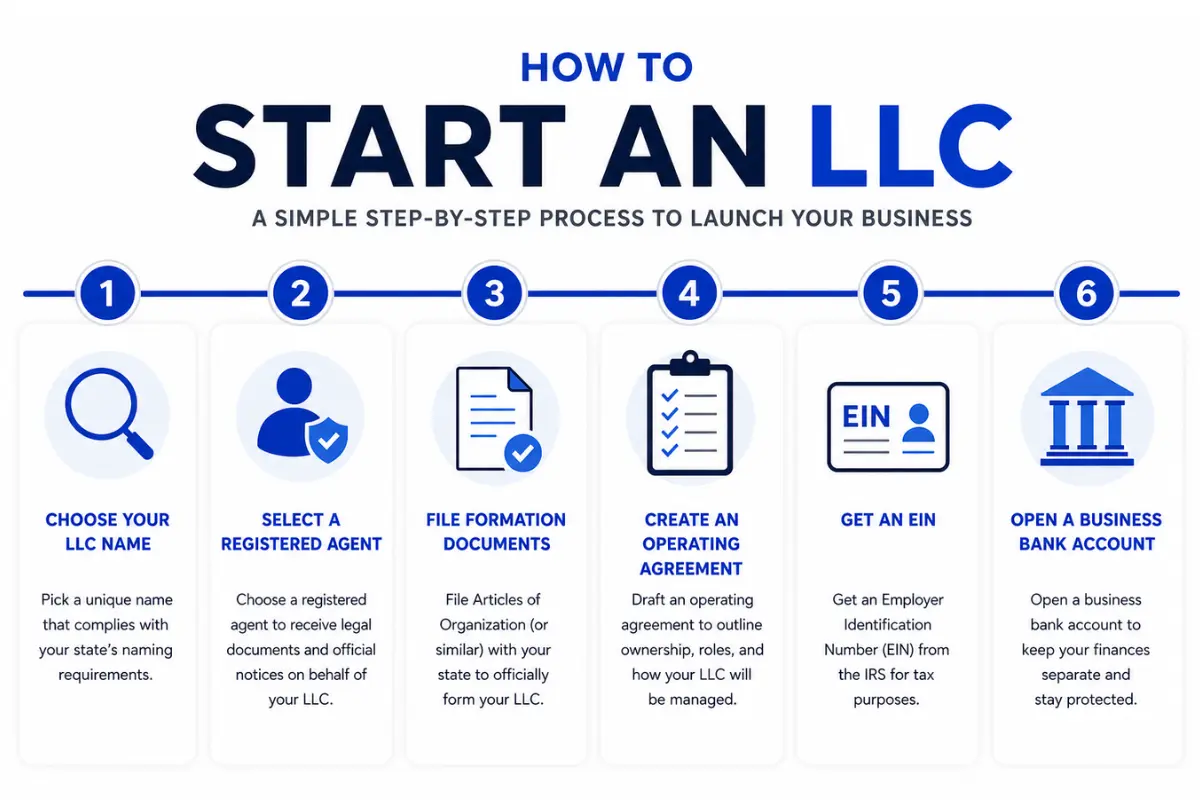
1. Choose Your LLC Name
Your LLC name has to follow your state’s naming rules. Most states require you to include “LLC” or “Limited Liability Company” in the name. Beyond that, your name cannot be identical or too similar to another registered business in your state.
Before committing to a name, do your homework. Run it through your state’s business name search tool to confirm availability, then check the U.S. Patent and Trademark Office database to verify it is not already federally trademarked. Confirming that a matching domain name is available is also worth doing early, so your business name and online presence stay consistent from the start.
2. Select a Registered Agent
Every LLC is required to have a registered agent, which is a person or company designated to receive official legal documents and government notices on behalf of your business. Think of them as your business’s point of contact for anything official.
Your registered agent must have a physical address in the state where your LLC is formed and be available during normal business hours. You can serve as your own agent, but many business owners prefer using a professional registered agent service to keep their personal address off public records and make sure nothing important gets missed.
3. File Formation Documents
To officially create your LLC, you need to file formation documents with the state agency that handles business registrations, typically the Secretary of State’s office. Depending on your state, this document may be called Articles of Organization, a Certificate of Formation, or a Certificate of Organization, but the purpose is the same.
The U.S. Small Business Administration notes that most businesses must register with state agencies, making the formation filing a required step to legally establish your LLC.
Once approved, your LLC officially exists.
4. Create an Operating Agreement
An operating agreement is an internal document that defines how your LLC will be run: ownership percentages, profit splits, decision-making authority, and what happens if a member wants to leave.
Some states require one, but even where it is optional, you should still have it. Without one, your state’s default LLC laws fill in the gaps, and they might not reflect what you and your co-owners actually want. If you are wondering how an LLC agreement compares to an operating agreement, we break down the differences in detail.
5. Get an EIN
An Employer Identification Number, or EIN, is essentially a Social Security number for your business. You need it to open a business bank account, hire employees, and file federal taxes.
The Internal Revenue Service requires most LLCs with more than one member, or those hiring employees, to obtain an Employer Identification Number (EIN).
Most LLCs, including multi-member and many single-member LLCs, are required to or will benefit from obtaining an EIN for tax filing and banking purposes. Our team can help with a standalone EIN application separate from your formation if needed.
6. Open a Business Bank Account
With your LLC formed and your EIN secured, a dedicated business bank account is the next logical step. Mixing personal and business finances, even occasionally, can weaken the legal separation your LLC is built on and put your personal assets at risk. A separate account keeps your finances clean, simplifies tax filing, and reinforces that your LLC is truly its own legal entity.
How Do I Start an LLC Online?
You do not need to walk into a government office to start an LLC. In virtually every state, the entire process can be completed online through your state’s Secretary of State website.
If you go the DIY route, you will fill out your formation documents, pay the filing fee, and wait for approval. It is straightforward in theory, but small mistakes on the form can cause delays or rejections that set your launch back.
That is where a professional formation service like DoMyLLC comes in. Our team handles the filing on your behalf, reviews your information for accuracy, and keeps you updated throughout the process so nothing gets missed.
How Much Does It Cost to Start an LLC?
How much it costs to start an LLC depends on your state and what services you use. State filing fees are the main cost and typically run between $50 and $500. Here is a breakdown of what to expect:
State filing fee: $50 to $500 depending on the state
Registered agent service: $100 to $300 per year
Operating agreement: Varies if you use a professional service
Business licenses and permits: Varies by industry and location
EIN application: Costs vary based on whether it is included in your formation package or completed as a standalone service
Beyond the initial formation, plan for ongoing compliance costs like annual report fees, which most states charge every year. These are typically much smaller than the upfront fees but add up over time if you are not prepared for them.
The bottom line is that starting an LLC is affordable for almost anyone. The upfront cost is minimal compared to the financial risk of running a business without liability protection.
Best State to Start an LLC
For most people, the best state to start an LLC is the state where you actually live and do business. That is the simplest and most cost-effective path.
You have probably heard about popular LLC states like Delaware and Wyoming. Delaware is well-known for its business-friendly laws and is a top choice for companies pursuing investment capital. Wyoming offers no state income tax and strong member privacy protections.
But here is the catch: if you form in Wyoming and live in California, you will likely still need to register as a foreign LLC in California. That means paying fees in two states with two sets of compliance requirements. Forming out-of-state only makes sense when there is a specific legal or tax reason for it.
Starting an LLC in Your State
While the core steps are the same everywhere, some states have unique requirements and costs worth knowing about. Here is a closer look at two of the most common state-specific searches.
How to Start an LLC in Texas
Texas is one of the more affordable states to form an LLC. The state filing fee for a Certificate of Formation is $300. Texas requires a registered agent with a Texas physical address but does not mandate a separate operating agreement by law.
There is no state income tax in Texas, which is a big plus for business owners. Annual reports are filed with the Comptroller’s office and are due each year by May 15.
How to Start an LLC in California
Learning how to start an LLC in California means budgeting for more than just the filing fee. The Articles of Organization cost $70, but California also charges an $800 annual franchise tax on all LLCs regardless of income, starting in the second year.
LLCs with higher revenue face additional fees on top of that. California also requires an initial Statement of Information within 90 days of formation, followed by biennial filings. If California is where you do business, it is where you need to be registered.
Common Mistakes When Starting an LLC
- Even a simple process has room for error. Here are the most common missteps people make when starting an LLC, and how to avoid them.
- Choosing the wrong state: Forming in a state other than where you operate can cost you double the fees with no real benefit.
- Missing compliance deadlines: Failing to file annual reports on time can lead to penalties or even losing your LLC status altogether.
- Not separating personal and business finances: The moment you mix personal and business money, you risk piercing the corporate veil and losing your liability protection.
- Skipping the operating agreement: Even if your state does not require one, going without it is like starting a road trip without a map. Things can get complicated fast, especially if you have partners.
Why Start an LLC Instead of Staying a Sole Proprietor?
If you are doing business without a formal structure, you are technically operating as a sole proprietor. And while that works for very small ventures, it comes with a serious downside: unlimited personal liability. Your savings, your car, your home, all of it is exposed if a client sues or a debt goes unpaid.
There is also a tax advantage. The Internal Revenue Service explains that LLCs are not taxed directly at the entity level by default. Instead, profits typically pass through to the owners’ personal tax returns.
That means you avoid the double taxation that hits C-corporations. You also gain credibility. Clients and vendors perceive an LLC as more established and trustworthy than a sole proprietorship operating under a personal name.
FAQs About Starting an LLC
Processing times vary by state, ranging from one business day to four weeks. Expedited processing is available in most states for an additional fee. Using a formation service helps avoid delays from paperwork errors.
Absolutely. A single-member LLC is one of the most common structures in the country. Many freelancers, consultants, and solo business owners choose this route for the protection and tax flexibility it provides.
No. Many business owners successfully start an LLC using an online formation service. If your situation involves complex ownership or multiple partners, consulting an attorney alongside a formation service is a smart move.
You need at least enough to cover your state's filing fee, which can be as low as $50. Filing directly with the state yourself is the lowest-cost path, though it requires more time and attention to detail.
The main drawback is ongoing compliance. Annual reports, fees, and recordkeeping are part of the deal. In some states like California, the annual franchise tax adds real cost. For most business owners, the protection and tax flexibility far outweigh these requirements.
Technically, the law does not always require it, but opening a dedicated business bank account is one of the smartest things an LLC owner can do. Mixing personal and business finances in the same account can "pierce the corporate veil," which means a court could decide your LLC is not truly a separate entity and hold you personally liable for business debts. A separate business account keeps your personal assets protected, makes tax filing cleaner, and helps you build business credit over time. Many small business owners also find it helpful to pair their account with a business credit card to further separate expenses.
By default, the Internal Revenue Service does not treat an LLC as a separate tax-paying entity. Instead, profits and losses pass through to the LLC members and get reported on their personal tax returns, which avoids the double taxation that hits C-corporations. Single member LLCs are taxed like a sole proprietorship, while multi member LLCs are taxed like a general partnership by default. LLC owners do need to account for self employment tax on their share of profits, though electing S-Corp tax status can reduce that burden for higher-earning businesses. If you are unsure how your LLC will be taxed at the federal, state, or local level, including any sales tax or excise taxes that may apply, consulting a tax professional is always a smart move.
All three offer some form of limited liability protection, but they work differently. A limited partnership has at least one general partner with unlimited personal liability and one or more limited partners who are protected. A limited liability partnership, commonly used by professional firms, protects individual partners from the actions of other partners but may not offer the same broad liability protection as an LLC. An LLC provides limited personal liability to all its members regardless of their role, along with a flexible management structure and favorable tax treatment. For most small business owners looking for a straightforward process with strong personal asset protection, an LLC is the more practical and versatile choice compared to these other business entities.
Yes, in most cases. Filing your LLC formation documents with the state's office legally creates your business entity, but it does not automatically grant you permission to operate in your industry or location. Depending on your business type and where you operate, you may still need a state or local business license, a sales tax permit, a federal employer identification number used as your federal tax identification number for banking and tax purposes, or industry-specific permits. Requirements vary widely, so check with your state and local government after your LLC filing is complete. Skipping this step can lead to fines or being forced to shut down, even if your LLC formation was done correctly.
Conclusion
Starting an LLC is one of the best early decisions you can make as a business owner. The steps are manageable, but the details matter. A missed deadline, an incorrect filing, or an overlooked requirement can delay your launch or put your liability protection at risk.
Working with a professional formation service like DoMyLLC means you do not have to figure it all out on your own. We make sure your LLC is formed correctly, your compliance obligations are tracked, and your business is built on a solid foundation from day one.
The investment is small compared to the protection and credibility you gain. Starting an LLC is one of the best early decisions you can make as a business owner, and doing it right the first time makes all the difference.
Start Your LLC the Right Way
Starting an LLC is one of the smartest moves you can make for your business. And when you are ready to take that step, you do not have to do it alone.
DoMyLLC handles the paperwork and filings from start to finish, giving you confidence that your LLC is set up correctly from day one. Reach out to our team today and let’s get your business started the right way.
Disclaimer: This content is intended for general educational and informational purposes only and does not constitute legal, tax, or accounting advice. Every effort is made to keep the information current and accurate; however, laws, regulations, and guidance can change, and no representation or warranty is given that the content is complete, up to date, or suitable for any particular situation. You should not rely on this material as a substitute for advice from a qualified professional who can consider your specific facts and objectives before you make decisions or take action.