

LLC vs Sole Proprietorship: Key Differences, Pros, Cons & Costs (2026)
It only takes one lawsuit, one unpaid debt, or one unhappy client to put everything you own at risk. Your car, your savings, your home. All of it potentially on the line because of how your business is structured. Most people don’t think about this until it’s too late.
The difference between an LLC and a sole proprietorship isn’t just paperwork. It’s the legal wall that either protects you or leaves you fully exposed. The DoMyLLC guide below covers everything you need to make the right call for your business.

Key Takeaways
- LLCs offer limited liability protection, which means your personal assets are generally shielded from business debts and lawsuits.
- Sole proprietorships are the simplest and least expensive business structure to start, but they leave your personal finances fully exposed.
- Both structures typically use pass-through taxation, so business income flows to your personal tax return.
- LLCs can improve your credibility with clients, lenders, and investors.
- The right business structure depends on your goals, your risk tolerance, and where you want to take your business.
What Is a Sole Proprietorship vs LLC?
Before comparing the two, it’s worth understanding exactly what each business entity is and why that distinction matters when you’re building something real.
What Is a Sole Proprietorship?
A sole proprietorship is the most basic business structure there is. If you start earning money without formally registering a legal entity, you’re automatically operating as one: no paperwork, no state filing fees, no setup required.
According to the IRS, A sole proprietor is someone who owns an unincorporated business by themselves. That simplicity comes at a cost. There’s no separation between you and your business, which means your personal assets are on the line for any debt or lawsuit the business faces.
What Is an LLC?
A Limited Liability Company (LLC) is a separate legal entity created under state law by filing formation documents, often called articles of organization, with your state. It’s a hybrid structure that combines the liability protection of a corporation with the flexibility and pass‑through tax treatment often associated with partnerships, which is why it’s become one of the most common choices for small business owners.
Unlike a sole proprietorship, an LLC is legally distinct from its owners, creating a barrier between your personal finances and your business. If the business incurs debts or is sued, your personal assets are generally not responsible for those obligations; usually, only the LLC’s assets and your investment in the company are at risk, unless you personally guarantee a debt or engage in fraud or other wrongful acts.
LLC vs Sole Proprietorship: Quick Comparison Table
| Feature | Sole Proprietorship | LLC |
|---|---|---|
| Liability Protection | None; owner’s personal assets are exposed | Personal assets generally shielded from business debts |
| Tax Treatment | Pass-through, reported on Schedule C | Pass-through by default; corporate elections available |
| Startup Costs | Minimal; no state formation fee | State filing fee, typically tens to low hundreds of dollars |
| Ongoing Requirements | Basic tax filing and licenses | Possible annual report, registered agent, and state fees |
| Ownership Flexibility | Single individual owner only | One or multiple members allowed |
| Credibility | May appear less formal to outsiders | Often seen as more formal and professional |
LLC vs Sole Proprietorship: Key Differences
Let’s get into the details that matter most when choosing between these two structures.
Personal Liability Protection
This is the biggest difference between an LLC and a sole proprietorship, and it’s often the deciding factor.
As a sole proprietor, you have unlimited personal liability for business debts. If a client sues you, a vendor doesn’t get paid, or an accident occurs on the job, your personal assets are on the table. There’s no legal wall between what belongs to you and what belongs to the business.
Consider a freelance designer sued over a project dispute. As a sole proprietor, her personal bank account, car, and property could all be at risk. The same situation with an LLC typically limits exposure to the business’s own assets. An LLC limits personal liability to the owner’s investment, which can make an enormous difference in a worst-case scenario.
Formation and Maintenance Requirements
A sole proprietorship doesn’t require formal registration with the state. You might need a local business license or a DBA (doing business as) filing if you want to operate under a name other than your own, but there are no formation documents, no state filing fees, and no annual reports.
An LLC, on the other hand, requires you to file Articles of Organization with your state, pay a filing fee (typically $50 to $500 depending on the state), and maintain a registered agent. Most states also require annual reports and fees to keep the LLC in good standing.
As explained by the U.S. Small Business Administration, If your business is a limited liability company, corporation, partnership, or nonprofit corporation, you’ll probably need to register with any state where you conduct business activities. A registered agent receives official papers and legal documents on behalf of your company. The registered agent must be located in the state where you register.
Business Credibility
When you operate as an LLC, that designation communicates professionalism. LLCs are perceived as more credible by clients, lenders, and investors. Many larger companies require vendors and contractors to operate as formal business entities before signing contracts. Banks are also more willing to extend business loans to LLCs. Sole proprietorships are generally less appealing to lenders and harder to finance.
Ownership and Growth Potential
Sole proprietorships have one owner. An LLC can have a single member or multiple members, making it easier to bring in partners or investors over time. LLCs also make it easier to transfer ownership as the business evolves.
LLC vs Sole Proprietorship Taxes
Taxes are one of the most-searched aspects of this comparison, and for good reason. Your business structure directly affects how much you pay and how you pay it.
How Sole Proprietorship Taxes Work
Sole proprietors report business income on Schedule C of Form 1040, attached to their personal income tax return. This is pass‑through taxation: the business itself does not pay income tax; profits and losses are taxed on the owner’s return. Sole proprietors are also responsible for self‑employment tax, which covers Social Security and Medicare and is charged at 15.3% on most net earnings from self‑employment.
As outlined by the IRS in Tax Topic 554, You usually must pay self‑employment tax if you had net earnings from self‑employment of 400 dollars or more. Generally, the amount subject to self‑employment tax is 92.35% of your net earnings from self‑employment. The IRS further notes that this includes “the member of a single‑member LLC that’s disregarded for federal income tax purposes,” meaning those owners are treated the same way as sole proprietors for income and self‑employment tax.
How LLC Taxes Work
By default, LLCs are classified as pass-through entities for tax purposes. A single-member LLC is taxed the same as a sole proprietorship, with income reported on Schedule C. A multi-member LLC is taxed as a partnership by default, with income passing through to each member’s personal return.
However, LLCs have a flexibility that sole proprietorships don’t: they can elect to be taxed as a corporation, including as an S Corporation, which can create meaningful tax savings for profitable businesses.
Single-Member LLC vs Sole Proprietorship Taxes
From a tax standpoint, a single‑member LLC and a sole proprietorship look nearly identical by default: both typically report business income on Schedule C and pay self‑employment taxes on their net earnings. The main difference is not how the income is taxed, but that an LLC can provide limited liability protection for your personal assets while you earn that income.
Can an LLC Reduce Taxes?
Yes, in some situations. An LLC can elect S Corporation status, which lets the owner split income between a salary and business distributions. Only the salary is subject to payroll taxes, which can reduce the overall self-employment tax burden significantly. This strategy works best once your business is generating consistent profit. Read up on the LLC vs S Corp comparison to see if it applies to you.
LLC vs Sole Proprietorship Costs
Cost to Start a Sole Proprietorship
Starting a sole proprietorship costs almost nothing. You may need a local business license and, if you want to operate under a business name that isn’t your own, a DBA filing. Read more about the DBA vs LLC comparison to see which route makes sense.
Cost to Form an LLC
Forming an LLC involves state filing fees, typically ranging from $50 to $500. You’ll also need a registered agent and, ideally, an LLC operating agreement. Formation services like DoMyLLC handle the paperwork and filing so you don’t have to navigate state requirements on your own.
Ongoing Compliance Costs
Sole proprietorships generally have very low ongoing compliance costs beyond standard business licenses, permits, and taxes. In contrast, LLCs in most states must file periodic reports, pay state fees, maintain a registered agent, and may be subject to franchise or similar entity‑level taxes. Closing an LLC usually requires formal dissolution filings with the state, while a sole proprietorship can typically be ended simply by ceasing operations and wrapping up any required final tax and license filings.
Which Option Is More Cost-Effective?
Upfront, a sole proprietorship wins on cost. Long-term, an LLC often pays for itself. The cost of a lawsuit or business debt that targets your personal assets can far exceed what you’d have paid in filing fees. For many business owners, that protection is well worth it.
Benefits of LLC vs Sole Proprietorship
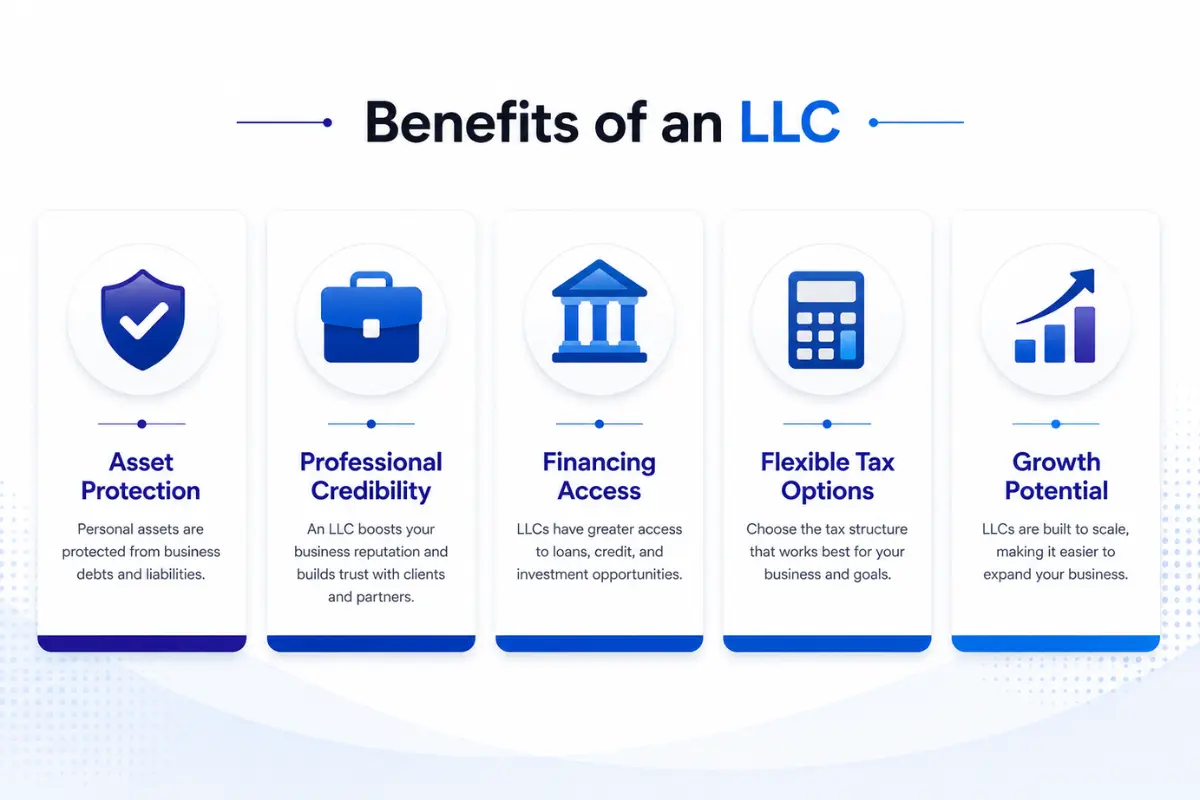
Personal Asset Protection
This is the core reason most business owners choose an LLC. When your business is a separate legal entity, your personal finances stay out of the equation in the event of a legal dispute or financial difficulty.
According to the U.S. Small Business Administration, LLCs protect you from personal liability in most instances, your personal assets, like your vehicle, house, and savings accounts, won’t be at risk in case your LLC faces bankruptcy or lawsuits. Profits and losses can get passed through to your personal income without facing corporate taxes. However, members of an LLC are considered self-employed and must pay self-employment tax contributions towards Medicare and Social Security.
Professional Business Image
Adding “LLC” to your business name signals legitimacy to clients, partners, and vendors. That credibility can open doors to larger contracts, wholesale accounts, and business partnerships that might otherwise stay closed.
Easier Access to Financing
An LLC can open a dedicated business bank account, build business credit, and apply for loans under the company’s name. Sole proprietorships are harder to finance and generally less appealing to lenders and investors.
Greater Long-Term Flexibility
LLCs offer flexible tax options, including S Corporation election. They can also add members and transfer ownership more easily than a sole proprietorship as the business grows.
Separation Between Business and Personal Finances
Keeping personal and business finances separate is essential to maintaining your LLC’s liability protection. Mixing them risks losing that legal barrier, known as “piercing the corporate veil.” A dedicated business bank account is the first step.
LLC vs Sole Proprietorship Pros and Cons
Here’s a clear side-by-side view:
- ✓Very low cost to start
- ✓Simple setup, minimal paperwork
- ✓Owner has complete control
- ✓Easy to shut down
- ✕Unlimited personal liability
- ✕Harder to get business loans
- ✕Less attractive to investors
- ✕No legal separation of personal and business finances
- ✓Limited liability protection
- ✓More credibility with lenders and clients
- ✓Flexible tax options (can elect S corp)
- ✓Can add members and scale
- ✕State filing fees
- ✕Annual reports and state fees
- ✕More ongoing paperwork and records
- ✕Formal dissolution filing required
Sole Proprietorship Pros
No registration, no fees, minimal paperwork. Complete control, easy to close, and simple enough for someone testing an idea or earning low-risk side income.
Sole Proprietorship Cons
Unlimited personal liability is the defining weakness. Creditors can pursue your personal assets, and sole proprietorships are harder to finance and less credible with lenders.
LLC Pros
Limited liability protection, flexible tax options, the ability to add members, and a more professional image. LLCs also make it easier to manage growth and access financing.
LLC Cons
Filing fees, annual reports, and registered agent obligations add administrative responsibility. For very early-stage businesses with minimal risk, those costs may feel premature.
Is an LLC Worth It for a Small Business?
For most serious business owners, yes. But the right answer depends on your specific situation. When weighing your options, it helps to look at the best business structure for your business goals.
When a Sole Proprietorship May Make Sense
If you’re testing a side hustle, freelancing with low risk, or just exploring an idea before committing, a sole proprietorship can be a reasonable starting point. Many businesses start this way and transition to an LLC once the income and exposure justify it.
When an LLC Is Usually the Better Choice
If you have clients, sign contracts, hire employees, carry inventory, or work in an industry where mistakes can lead to lawsuits, an LLC is worth the investment. The same goes for anyone who has meaningful personal assets they want to protect. A business that generates real income and faces real risk deserves a real legal structure.
Income Thresholds and Considerations
Many people think an LLC only makes sense once their business hits a certain income level, but that is not how the law works. In practice, your liability exposure is often more important than your revenue. A $30,000 annually business that works on‑site with clients or handles their property can still face meaningful legal risk, even if it is small. Revenue is one factor when choosing an entity, but it is far from the only one.
How to Change From a Sole Proprietorship to an LLC
Ready to make the move? Here’s what the process looks like. You can also find step-by-step guidance on how to start an LLC in our resource center.
Choose a Business Name
Your LLC name must be unique in your state and include “LLC” or “Limited Liability Company.” Check your state’s business name database for availability before filing.
File Formation Documents
File your Articles of Organization with your state’s business filing office along with the required fee. Each state has its own process, so review the requirements or work with a formation service.
Obtain an EIN
An Employer Identification Number (EIN) is your business’s tax ID. It’s needed to open a business bank account and file taxes. Our guide on how to get an EIN number walks through the process.
Open a Business Bank Account
A dedicated business bank account separates your personal and business finances, which is essential for maintaining your LLC’s liability protection.
Update Contracts and Licenses
Transition existing contracts, licenses, and accounts to the new LLC. Update business licenses and permits, and notify clients and vendors of the change.
Need Help Forming an LLC?
Forming an LLC involves more steps than most people expect, and state requirements vary. Filing mistakes or missed compliance deadlines can cause real problems down the road.
Our team handles every step of the formation process, including filing your Articles of Organization, providing registered agent services, securing your EIN, and ensuring your business remains in good standing. Contact Us to get started.
Frequently Asked Questions
For most business owners with clients, contracts, or personal assets to protect, an LLC is the better choice. A sole proprietorship works for low-risk testing, but unlimited personal liability becomes a real problem as the business grows.
There's no set number. Liability exposure often matters more than revenue. If you're working with clients or signing contracts, an LLC can be worth it at any income level.
Ongoing compliance: state filing fees, annual reports, and registered agent obligations add work that sole proprietorships don't require.
Unlimited personal liability is the biggest issue. Your personal assets are exposed to business debts and lawsuits, and sole proprietorships are harder to finance and less credible with lenders.
Both are pass-through entities by default. An LLC that elects S Corporation status can reduce self-employment taxes by splitting income between salary and distributions, which can produce meaningful savings.
Yes. File Articles of Organization, choose a business name, get an EIN, open a business bank account, and update existing contracts and licenses.
Tax treatment is similar by default, with both filing on Schedule C. But legally they're different. The LLC is a separate legal entity with liability protection. A sole proprietorship has no such separation.
Disclaimer: This content is intended for general educational and informational purposes only and does not constitute legal, tax, or accounting advice. Every effort is made to keep the information current and accurate; however, laws, regulations, and guidance can change, and no representation or warranty is given that the content is complete, up to date, or suitable for any particular situation. You should not rely on this material as a substitute for advice from a qualified professional who can consider your specific facts and objectives before you make decisions or take action.