

LLC vs Corporation: Pros, Cons, Taxes & How to Choose (2026)
Choosing between an LLC and a corporation is one of the most important decisions you will make as a business owner. Get it right and you could save thousands in taxes, protect your personal assets, and set your business up for long-term growth. Get it wrong and you could end up paying more than you need to, or facing compliance headaches down the road.
The good news? You don’t have to figure this out alone. At DoMyLLC, we help business owners compare their options and get properly formed from day one. In this guide, we’re breaking down the key differences between an LLC and a corporation, including how each is taxed, what it costs to maintain, and which structure makes the most sense depending on where your business is headed.
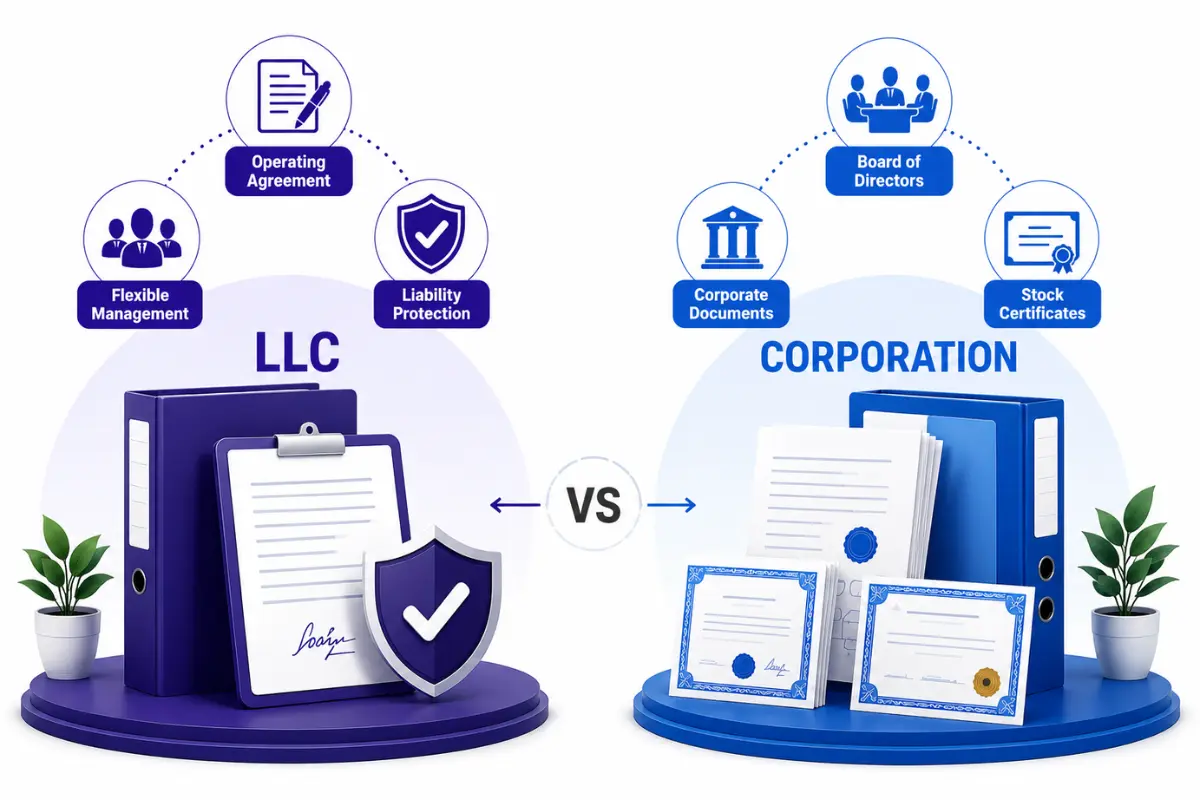
Key Takeaways
- LLCs offer flexible management and pass-through taxation by default.
- Corporations provide a more formal structure, better suited for raising investment capital.
- Both LLCs and corporations offer personal liability protection.
- Tax treatment differs significantly between LLCs, S corps, and C corps.
- The best choice depends on your business goals, growth plans, and tax situation.
- Professional formation services help you avoid costly mistakes from the start.
What Is an LLC vs Corporation?
What Is an LLC?
A limited liability company (LLC) is a separate legal entity formed under state law. It protects its owners, called members, from personal liability for business debts and obligations while offering significant flexibility in how it is taxed and managed. If you’re looking to form an LLC, the process typically involves filing Articles of Organization with your state and creating an operating agreement.
As defined by the U.S. Small Business Administration, A limited liability company (LLC) is a business structure that offers limited liability protection and pass-through taxation. As with corporations, the LLC legally exists as a separate entity from its owners. Therefore, owners cannot typically be held personally responsible for the business debts and liabilities.
In plain terms: if your LLC gets sued or takes on debt, your personal savings, car, and home are generally protected. That separation between personal and business assets is one of the most valuable things an LLC provides.
What Is a Corporation?
A corporation is a more formal legal entity owned by shareholders and governed by a board of directors. There are two main types: C corporations and S corporations. C corporations are taxed separately from their owners and face double taxation. S corporations pass income through to shareholders’ personal tax returns, avoiding that second layer of tax.
LLC vs Corporation: Quick Comparison Table
Here’s a side-by-side look at how these structures compare across the most important factors:
| Feature | LLC | C Corp | S Corp | Sole Proprietorship |
|---|---|---|---|---|
| Liability protection | Yes — limited liability for owners | Yes | Yes | No |
| Tax treatment | Pass-through by default; can elect C/S status | Double taxation (corp + dividends) | Pass-through (income taxed to shareholders) | Pass-through (reported by owner) |
| Management structure | Flexible; members or managers | Board of directors and officers | Same as C corp; board and officers | Owner managed |
| Startup costs | Low to moderate | Moderate to high | Moderate to high (corp plus S election) | Minimal |
| Ownership flexibility | Unlimited members (few restrictions) | Unlimited shareholders (broadly open) | Max 100 eligible U.S. shareholders | Single owner |
| Best suited for | Small/medium businesses needing flexibility | High-growth or venture-backed firms | Profitable small businesses with owner-employees | Freelancers and test ventures |
LLC vs Corporation: Key Differences
Personal Liability Protection
Both LLCs and corporations provide limited liability protection, meaning owners are not personally responsible for business debts and lawsuits. This protection is often called the “corporate veil.” Keep your personal and business finances separate, follow your entity’s rules, and that veil holds.
Compare that to sole proprietorships, where there is no separation between you and your business. Personal assets are fully exposed to business risks, which is why most serious business owners move away from that structure quickly.
Management Structure
LLCs offer greater flexibility in management than corporations. An LLC can be managed by its members, meaning the owners run the company directly, or by appointed managers who may not be members. The LLC’s operating agreement outlines management roles, profit distribution, and membership details. This document is the backbone of how an LLC functions day to day.
Corporations require a formal structure with a board of directors, corporate officers, and shareholders. Corporations must hold annual shareholder meetings and record minutes, adding administrative overhead that many small business owners find unnecessary.
Formation and Ongoing Compliance Requirements
Both LLCs and corporations must register with the state and file periodic (often annual) reports, but corporations generally face stricter formalities. LLCs usually have fewer mandated formalities and, in most states, are not required to hold annual meetings or keep minutes, though doing so is recommended. Corporations typically must file annual reports, hold annual shareholder meetings, and maintain detailed corporate records such as minutes and stock ledgers.
Registered Agent Requirements
Both LLCs and corporations must appoint a registered agent in every state where they are registered to do business. A registered agent is a person or company designated to receive legal documents, tax notices, and state correspondence on behalf of your business. This is a non-negotiable requirement, not an optional formality.
Ownership and Investment Potential
Corporations have a clear advantage when it comes to raising capital. They can offer different classes of stock, making it much easier to attract investors. Venture capitalists prefer corporations over LLCs because the ownership and equity structure is more familiar and transferable. If you are building a startup with plans to seek outside funding, a corporation is the typical path.
LLCs typically cannot issue stock, which limits fundraising options. Ownership in an LLC is structured through membership interests, and adding members to an LLC requires following the procedures outlined in the operating agreement. For most small businesses not seeking institutional investment, this is not a limitation that matters much in practice.
One thing to keep in mind: in some states, LLCs can have a limited lifespan if a member leaves and there is no operating agreement in place to address the situation. A well-drafted operating agreement protects against this risk.
LLC vs Corporation Taxes
How LLC Taxes Work
By default, LLCs are taxed as pass‑through entities, so profits and losses are reported on the members’ personal tax returns rather than taxed at the entity level. A single‑member LLC is usually treated like a sole proprietorship and reports business income on Schedule C, while a multi‑member LLC is treated like a partnership, filing Form 1065 and issuing Schedule K‑1s to members.
In a typical member‑managed LLC, each member’s share of business income is subject to self‑employment tax, which covers Social Security and Medicare. Because this can increase overall tax liability for profitable businesses, some LLC owners elect S corporation tax status to potentially reduce the portion of profits subject to self‑employment tax.
How Corporation Taxes Work
C corporations are separate tax‑paying entities, meaning the corporation itself files its own return and pays federal income tax on its profits, while shareholders pay personal income tax on any dividends they receive. This is what people refer to as “double taxation.”
As the IRS explains in its guidance on forming a corporation, corporations generally remain separate tax‑paying entities unless they elect to be treated as S corporations, and certain larger corporations are required to electronically file their corporate returns (Forms 1120 and 1120‑S) based on their asset size and the number of returns they file.
S Corporation vs LLC Taxes
S corporation taxation is a common strategy for LLC owners. When an LLC elects S corporation status, it is still treated as a pass‑through entity, but owners can divide their income between salary and distributions: salary is subject to payroll taxes, while distributions generally are not, which can reduce self‑employment tax for profitable businesses. Learn more about the specifics in our guide on LLC vs S corp tax differences.
To qualify for S corporation status, the business can have no more than 100 eligible shareholders, typically U.S. individuals plus certain trusts, estates, and tax‑exempt organizations. S corporation shareholders report their share of income on their personal tax returns, and the S corporation itself generally does not pay federal income tax on that pass‑through income.
C Corporation vs LLC Taxes
The key tax difference between a C corporation and an LLC is that C corporations are generally subject to double taxation, while LLCs are typically taxed as pass‑through entities. C corporations pay federal income tax at the corporate level, and shareholders may pay additional tax on dividends, whereas LLC profits are usually taxed only once at the owner level. Under current law, C corporation income is taxed at a flat 21% federal rate, which can be lower than the top individual income tax rates that may apply to pass‑through income for high‑earning owners.
Which Structure Offers Better Tax Advantages?
For most early-stage businesses, an LLC with potential S corp election considerations offers the most flexibility and tax efficiency. For businesses seeking venture capital or planning for significant scale, a C corp may make more sense despite the double taxation.
LLC vs Corporation Costs
Cost to Form an LLC
State filing fees for an LLC typically range from about $50 to $500, depending on the state. You’ll also need to budget for a registered agent, an operating agreement, and potentially a formation service, and some states charge an annual franchise tax on LLCs as well.
Cost to Form a Corporation
Incorporating usually costs more upfront. Articles of Incorporation, registered agent fees, bylaw preparation, and initial organizational actions all add up, and the gap often widens once you factor in ongoing compliance requirements.
Ongoing Compliance Costs
Corporations generally carry higher ongoing compliance costs. They must file annual reports, pay franchise taxes in many states, hold annual shareholder meetings, maintain corporate records, and keep up with various legal and tax obligations; annual report filing is required for both LLCs and corporations in most states, but the full corporate compliance calendar is typically more demanding.
LLCs usually have fewer administrative requirements and lower compliance costs by comparison; while you still need to stay current on state filings and registered agent requirements, the day‑to‑day compliance burden is generally lighter.
Which Is More Cost-Effective?
For most small businesses, an LLC is more cost-effective. The value of a corporation becomes clearer as your business grows, takes on investors, or prepares for an exit. The additional corporate structure is worth paying for when your business actually needs it.
LLC vs Corporation Pros and Cons
- ✓Personal liability protection keeps most personal assets separate from business debts and lawsuits
- ✓Pass-through taxation means no corporate-level income tax by default
- ✓Flexible management structure; can be member-managed or manager-managed
- ✓Generally lower compliance burden and fewer formal administrative requirements than corporations
- ✓Tax flexibility: LLCs can elect to be taxed as C or S corporations when it benefits the owner
- ✕Members pay self-employment taxes on most profits unless an S corp election is made
- ✕Cannot issue traditional stock, which can limit options for raising investment capital
- ✕LLC laws vary by state, so compliance requirements differ depending on where you operate
- ✕Some states charge higher annual fees or franchise taxes on LLCs
- ✕In some states, an LLC can dissolve if a member leaves without a solid operating agreement
- ✓Strong personal liability protection reassuring to investors and courts
- ✓Stronger access to capital through stock sales and can offer different classes of stock
- ✓Venture capitalists and institutional investors are generally more comfortable with the corporate structure
- ✓Potential tax advantages through the flat 21% federal corporate tax rate, depending on profits and distributions
- ✓“Inc.” often carries weight with clients, partners, and lenders
- ✕C corporations face double taxation on profits and dividends
- ✕Stricter legal and regulatory requirements, including annual shareholder meetings and formal corporate records
- ✕Formation and ongoing compliance costs are typically higher than for LLCs
- ✕Less flexibility in management with mandatory board structures and corporate officers
LLC Pros
- Personal liability protection keeps most personal assets separate from business debts and lawsuits.
- Pass-through taxation means no corporate-level income tax by default.
- Flexible management structure; can be member-managed or manager-managed.
- Generally lower compliance burden and fewer formal administrative requirements than corporations.
- Tax flexibility: LLCs can elect to be taxed as C or S corporations when it benefits the owner.
According to the U.S. Small Business Administration, LLCs protect you from personal liability in most instances, your personal assets like your vehicle, house, and savings accounts won’t be at risk in case your LLC faces bankruptcy or lawsuits. Profits and losses can get passed through to your personal income without facing corporate taxes.
LLC Cons
- In a typical member-managed LLC, members pay self-employment taxes on most or all business profits unless an S corp election is made.
- LLCs typically cannot issue traditional stock, which can limit options for raising investment capital.
- LLC laws vary by state, so compliance requirements differ depending on where you operate.
- Some states charge higher annual fees or franchise taxes on LLCs.
- In some states, an LLC can dissolve if a member leaves and there is no solid operating agreement in place.
Corporation Pros
- Corporations provide strong personal liability protection in most cases, which can be reassuring to investors and courts.
- Corporations have stronger access to capital through stock sales and can offer different classes of stock.
- Venture capitalists and institutional investors are generally more comfortable with the corporate structure.
- Potential tax advantages for some high-earning owners through the flat 21% federal corporate tax rate, depending on how profits and distributions are structured.
- Established credibility: “Inc.” often carries weight with clients, partners, and lenders.
Corporation Cons
- C corporations face double taxation on profits and dividends.
- Corporations face stricter legal and regulatory requirements, including holding annual shareholder meetings and maintaining formal corporate records.
- Formation and ongoing compliance costs are typically higher than for LLCs.
- Less flexibility in management compared to LLCs, with mandatory board structures and corporate officers.
LLC vs Corporation for Small Business
When an LLC Is Usually the Better Choice
For many small businesses, service providers, freelancers, and real estate investors, an LLC is often the more practical starting point. It provides limited liability protection, pass-through taxation by default, flexible management, and fewer formal governance requirements than a corporation. You don’t need a board of directors to run a plumbing company, consulting practice, or rental property portfolio.
If you primarily want liability protection and straightforward taxation, an LLC usually delivers both without the added complexity of corporate formalities.
When a Corporation Makes More Sense
Corporations are usually the better fit when outside equity investment is a key goal. If your startup plans to raise venture capital, issue stock or stock options to employees, or eventually go public, a C corporation is typically what investors expect. A corporation can also be preferable for businesses with multiple owners and complex ownership arrangements that benefit from formal governance structures.
LLC vs Inc: What Is the Difference?
LLC stands for limited liability company. “Inc.” indicates an incorporated business, meaning it is a corporation. Both structures create a separate legal entity that can provide limited liability protection for owners, but they differ in governance, compliance obligations, and tax treatment. If you see “Inc.” in a business name, it is a corporation; if you see “LLC,” it is a limited liability company, not a corporation.
LLC vs Corporation vs S Corp: Which Should You Choose?
An LLC is generally the most flexible option, with relatively simple formation, default pass-through taxation, and fewer formal compliance requirements. A C corporation is typically used for high‑growth businesses that expect to raise outside investment. An S corporation sits in between: it has corporate governance, but offers pass‑through taxation and the ability to split owner income between salary and distributions, while limiting ownership to 100 eligible U.S. shareholders. Many owners start with an LLC and later elect S corporation tax status once profits are high enough to justify the added complexity.
LLC vs Corporation vs Sole Proprietorship: Where Do You Start?
If you are testing a simple business idea, a sole proprietorship is the easiest path, with no separate formation filing or entity-level paperwork, but it offers no liability separation, so your personal assets are exposed to business debts and claims. Forming an LLC adds limited liability protection and some structure without a large increase in day-to-day complexity.
A corporation is usually the next step when investors, equity compensation, or more complex ownership structures become part of the plan.
DBA vs LLC vs Corporation: What About a Trade Name?
A DBA (doing business as) allows a business to operate under a name different from its legal name. It is not a business structure and does not provide liability protection on its own. Both LLCs and corporations can register a DBA, but a DBA by itself is only a naming tool, not a separate legal entity or liability shield.
Ready to Form Your LLC or Corporation?
Picking the right business structure is the foundation of everything you build from here. The wrong choice can cost you in taxes, expose you to liability, or create complications when it’s time to bring in investors or transfer ownership. The right choice sets you up to grow with confidence.
Our team makes the formation process simple, accurate, and stress-free. Whether you’re ready to form an LLC, form a corporation, or apply for an EIN, we handle the details so you can focus on your business. Contact us today to get started.
Frequently Asked Questions: LLC vs Corporation
For most small business owners, an LLC offers the best combination of liability protection, tax flexibility, and simplicity. For businesses seeking venture capital or planning to go public, a corporation is usually the better fit. Understanding your growth plans and tax situation before deciding makes all the difference.
For many profitable businesses, the main drawback is self-employment taxes. In a typical member-managed LLC, members pay self-employment taxes on most or all business profits by default, though electing S corp status can reduce that burden. Another limitation is the inability to issue traditional stock, which can make raising outside investment more challenging.
It depends on your tax election and income level. A C corporation pays 21% federal corporate tax on its profits, and shareholders may also pay personal income tax on dividends. A default LLC avoids corporate tax, but owners may pay self-employment taxes on most or all profits unless they elect S corp status. The total tax bill comes down to your specific income, distribution strategy, and long-term goals.
The "LLC loophole" typically refers to the S corp election strategy. By electing S corp status, LLC owners can split income between salary and distributions. Salary is subject to payroll taxes; distributions are not. This reduces the portion of income subject to self-employment taxes and is a legitimate strategy under the Internal Revenue Code, not an actual loophole.
For the vast majority of small businesses, an LLC is the better starting point. It provides liability protection, flexible taxation, and straightforward compliance without the administrative overhead of a corporation. If your small business grows to the point where you need investor capital, employee stock options, or a formal governance structure, you can always convert to a corporation later.
Yes. LLCs can convert to corporations as they scale. The process varies by state but typically involves filing conversion documents, updating tax status with the IRS, and addressing tax consequences. It's a significant step, so professional guidance is strongly recommended before making the move.
LLC refers to a limited liability company: flexible, pass-through taxation, minimal compliance. Inc refers to an incorporated business with a formal shareholder and board structure and stricter compliance requirements. Both provide personal liability protection, but they operate under different rules and are taxed differently. The right choice depends on your growth plans and tax situation.
Disclaimer: This content is intended for general educational and informational purposes only and does not constitute legal, tax, or accounting advice. Every effort is made to keep the information current and accurate; however, laws, regulations, and guidance can change, and no representation or warranty is given that the content is complete, up to date, or suitable for any particular situation. You should not rely on this material as a substitute for advice from a qualified professional who can consider your specific facts and objectives before you make decisions or take action.