

Do I Need an LLC? When It’s Worth Forming One
“Do I need an LLC?” If you’re asking yourself that right now, you’re in good company. Almost every business owner asks it at some point, usually right after that first sale or first client comes in.
Here’s the short answer: no, not always. Most businesses can legally run without one. But an LLC can protect your personal money and property, make your business look more credible, and give you more control over your taxes.
Say a freelance web designer just landed her biggest client yet. She’s excited, but she’s also signing a real contract and sending a bigger invoice than usual. If something goes wrong on the project, what happens to her personal savings? That question is exactly when an LLC stops being a “someday” thing and starts feeling like a real decision.
DoMyLLC helps people answer that exact question every day. In this guide, we’ll walk through what an LLC actually does, when it starts to make sense, and how to know if now is the right time for your business.

Key Takeaways
- An LLC isn’t legally required to run most businesses.
- Forming an LLC helps separate your personal assets from many business liabilities.
- There’s no set income level that automatically means you need an LLC.
- Many entrepreneurs start out as sole proprietors before switching to an LLC later.
- An LLC often becomes worth it once your business grows or takes on more risk.
- Some LLCs need an EIN by law, while others get one anyway for banking and taxes.
- Choosing the right business structure now can save you time, money, and headaches later.
What Is an LLC and How Does It Work?
A limited liability company, or LLC, is a business structure that draws a line between you and your business. Instead of you and your business being treated as one and the same, the LLC becomes its own separate legal entity.
That line matters more than most new owners think. Say a client slips in your shop, or a vendor says your business owes money it can’t pay. If you have an LLC, your personal things, your house, your car, your savings, are usually protected. It’s the business’s assets on the hook, not yours.
Picture a fence around your business. Inside the fence sits your business bank account, your equipment, and your business income. All of that can be reached if something goes wrong. Outside the fence is your personal life, and it stays protected as long as you keep the two separate and don’t sign personal guarantees or act negligently yourself.
LLCs also use pass-through taxation by default. The business itself generally doesn’t pay federal income tax. Instead, the profit and loss pass through to the owners, called LLC members, who report it on their own personal tax return. Single-member LLCs don’t file a separate federal income tax return; multi-member LLCs file an informational return (Form 1065) but still avoid double taxation.
Ownership is flexible too. An LLC can have one owner or many, and those owners can run the business themselves or bring in a manager to do it for them. It bends to fit your business instead of the other way around.
This mix of protection and flexibility is a big reason the LLC has become one of the most popular business structures for small business owners across the country. You get real legal protection without the heavy paperwork that comes with running a corporation.
According to the IRS, “A limited liability company (LLC) is a business structure allowed by state statute. Legal and tax considerations enter into selecting a business structure.”
Do You Need an LLC to Start a Business?
No, you don’t. Most businesses can legally get off the ground without one.
Plenty of entrepreneurs start out as sole proprietors, since it takes zero state-level paperwork to start invoicing clients, selling on Etsy, or picking up freelance work. You may still need local licenses, permits, or tax registrations depending on your location and industry, but you don’t need an LLC just to begin.
Take Maria, who started selling handmade candles online as a weekend hobby. She never filed anything with her state. She just opened a shop, listed her products, and started shipping orders. That’s a sole proprietorship in action, and it’s a completely normal, legal way to begin.
That said, some industries have licensing rules or professional entity requirements that affect your options. It’s worth checking what applies to your field before you assume you’re in the clear.
For most small businesses, forming an LLC is a choice, not a requirement. You form one once the benefits are worth more than the extra cost and paperwork, not because the law forces your hand.
The U.S. Small Business Administration puts it simply: an LLC lets you combine the benefits of both a corporation and a partnership.
So if an LLC isn’t required, why do so many business owners form one anyway? Let’s look at when it actually starts to pay off.
Do I Need an LLC for My Business?
Every business carries its own mix of risk, income, and goals, so the right answer looks different for everyone. Here are the situations where forming an LLC tends to make the most sense.
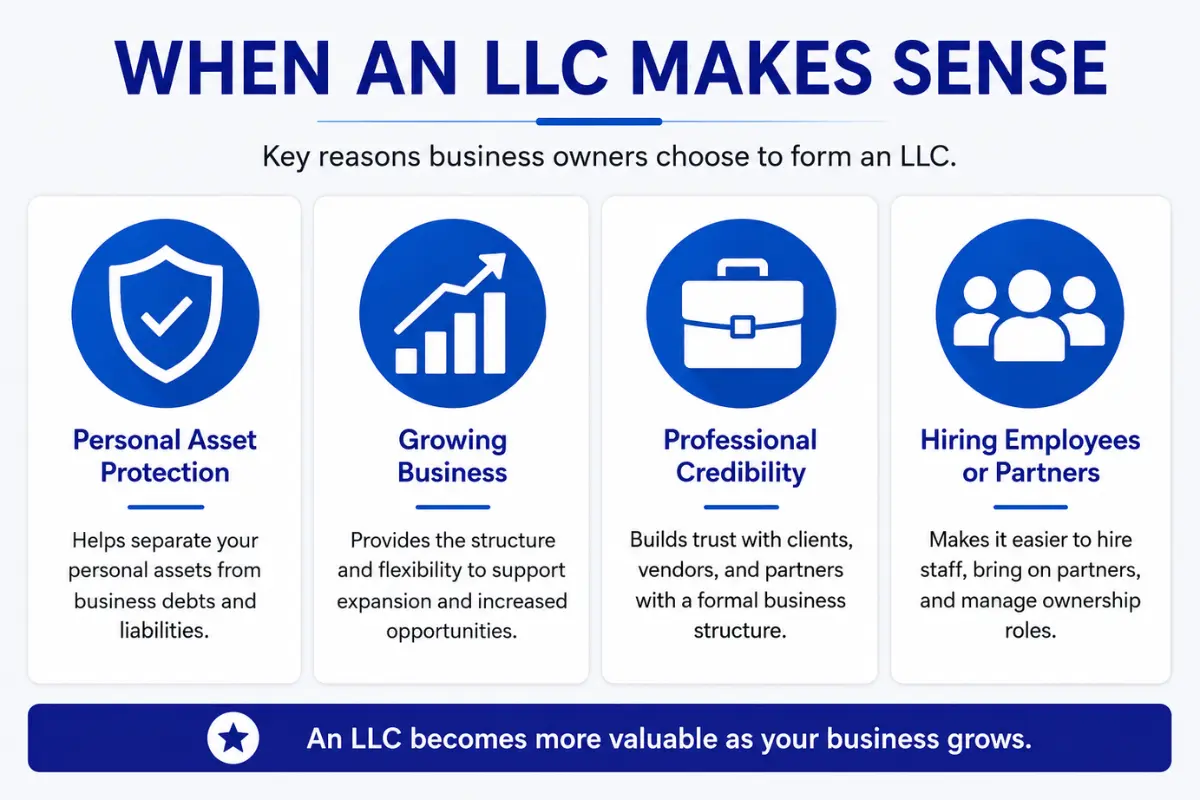
You Want Personal Liability Protection
If a customer sues you, a vendor doesn’t get paid, or your business takes on debt it can’t cover, an LLC keeps that mess separate from your personal life. In most cases, that means your personal bank account, car, and home are protected, while the LLC’s assets are what creditors and plaintiffs can reach. (The protection isn’t absolute. If you sign personal guarantees, act negligently yourself, or fail to keep business and personal finances separate, you could still be exposed.)
Without one, a lawsuit or unpaid bill could reach into your bank account, your car, or even your home.
You Want Greater Professional Credibility
Having “LLC” after your business name tells banks, vendors, and bigger clients that you’re running a real, established operation. It can make it easier to open a business bank account, get a business credit card, and win contracts with companies that only work with formal business entities.
Your Business Is Growing
More customers, higher revenue, and bigger contracts all mean more exposure. A side project bringing in a few hundred dollars a month is a very different animal than a business signing five-figure contracts, and your risk grows right along with your success.
You Plan to Hire Employees or Bring on Partners
Bringing on employees or business partners adds a layer of liability you’re not used to carrying alone. An LLC gives you a clear legal framework for sharing ownership, responsibilities, and profits, spelled out in an operating agreement instead of a handshake.
As your business grows, you may eventually add a business partner. Our guide on How to Add a Member to an LLC walks through how to update your LLC ownership the right way.
At What Point Do You Need an LLC?
There’s no magic income number where an LLC suddenly becomes required. It usually comes down to a few things adding up over time:
- Consistent revenue
- Regular clients
- Selling products
- Hiring employees
- Purchasing inventory
- Signing contracts
- Increased liability exposure
The more of these that apply to you, the stronger the case for forming an LLC. A single freelance gig here and there looks a lot different than a business with repeat customers, inventory in a storage unit, and contracts with your name on the line.
| Business Stage | Consider an LLC? |
|---|---|
| Testing a business idea | Usually No |
| Earning consistent income | Often Yes |
| Hiring employees | Yes |
| Opening a storefront | Yes |
| Growing online business | Usually Yes |
Usually No
Often Yes
Yes
Yes
Usually Yes
At What Point Is an LLC Worth It?
Forming an LLC does cost money. You’ll pay a state filing fee upfront, and in many states you’ll also owe annual fees or reports to stay in good standing.
Now weigh that against what you get back: liability protection, tax flexibility, and a more professional image with clients and lenders. Think of it like insurance on a car you drive every day. If your business is still parked in the garage, just an idea you’re testing, the cost may not be worth it yet. Once you’re on the road every day with customers, contracts, and money changing hands, that coverage starts to earn its keep.
For most owners with steady income, signed contracts, or any real liability risk, the protection and credibility outweigh the cost.
Our breakdown of the cost to start an LLC shows exactly what to expect in your state, filing fees and annual fees included.
Sole Proprietorship vs LLC
Here’s how the two most popular business structures for small business owners stack up side by side.
No
Yes
No
Yes
Lower
Higher
Limited
More Options
No
Yes
If you’re testing an idea with little risk and no employees, a sole proprietorship might be just fine for now. If you have paying customers, real liability, or plans to grow, an LLC is usually the stronger long term choice for your personal and business finances.
It also comes down to how much paperwork you’re willing to take on. A sole proprietorship keeps things simple with fewer forms. An LLC trades a little extra paperwork for a real legal line between you and your business.
For a closer look at how these two structures compare, our guide on LLC vs Sole Proprietorship breaks down the differences in more detail.
What Do You Need to Start an LLC?
If you decide an LLC is right for you, the process is pretty simple. Here’s what it usually takes, from picking a name to getting your state’s approval.
Choose a Business Name
Your LLC name has to follow your state’s naming rules. That usually means including “LLC” in the name and steering clear of words already registered by another business entity in your state.
Select a Registered Agent
Every LLC has to name a registered agent in its formation state. This is the person or company that receives legal notices and official state mail on behalf of your business.
Many owners choose a professional registered agent service instead of listing their own name and home address. It protects your privacy and makes sure nothing important slips through the cracks.
Learn more in our guide on what does a registered agent do.
File Articles of Organization
This is the document that officially creates your LLC with the state. It usually includes your business name, address, and registered agent information, along with the required filing fee.
Create an Operating Agreement
Even in states where it isn’t required, an operating agreement is worth having. It spells out who owns what, how decisions get made, and what happens if a member leaves. That can save a lot of headaches between business partners down the road.
Wait for State Approval
Approval timelines vary quite a bit by state, from same day processing to several weeks.
Our guide on how long it takes to form an LLC breaks down what to expect state by state.
Do I Need an EIN for My LLC?
An EIN, or Employer Identification Number, works a bit like a Social Security number for your business. Whether you need one depends on how your LLC is set up and what it does.
You’ll need an EIN if:
- You have a multi-member LLC (treated as a partnership by default),
- You plan to hire employees,
- You make certain IRS tax elections, like electing to be taxed as an S Corp or C Corp,
- You owe excise taxes (for example, certain fuel, tobacco, or alcohol-related taxes).
Some single-member LLCs without employees aren’t required to get an EIN for federal income tax purposes, since the owner can use their Social Security number instead. Even so, most owners get an EIN anyway, since most banks require it to open a business bank account, and it keeps business finances separate from personal ones.
As the IRS points out, most new single-member LLCs classified as disregarded entities will end up needing an EIN, especially if they have employees, owe excise taxes, or need one to open a business bank account. However, a single-member LLC with no employees and no excise tax liability is not required to have one for federal income tax purposes.
Pros and Cons of Forming an LLC
Like any business decision, forming an LLC comes with upsides and trade-offs. Here’s a quick side-by-side look so you can weigh both.
Benefits
- Personal liability protection
- Professional credibility
- Flexible taxation
- Easier banking
- Long-term growth potential
Drawbacks
- Filing fees
- Annual reports and fees
- Ongoing compliance requirements
How to Decide If You Need an LLC
Still on the fence? Ask yourself these questions.
- Do you have paying customers?
- Could your business be sued?
- Do you sign contracts?
- Are you making consistent income?
- Do you want to protect your personal assets?
- Do you expect your business to grow?
If you answered “yes” to several of these, forming an LLC is likely a smart next step.
Why Many Entrepreneurs Choose DoMyLLC
Starting an LLC involves more than filling out one form. You have to pick a registered agent, meet your state’s filing rules, and stay compliant long after your business is up and running.
We take that off your plate. Our team prepares and files your LLC paperwork, provides professional registered agent service, and helps you stay compliant as your business grows. That means less time buried in forms and more time doing the work you started your business to do.
Ready to make it official? Contact us to learn how we can help you form your LLC quickly and correctly.
FAQs
No. Most businesses can legally start without one, though forming an LLC does add liability protection and credibility as you grow.
Not necessarily, especially in the early testing stage. As your side hustle starts earning steady income or taking on more risk, an LLC becomes more worth considering.
There's no exact number or date. It usually makes sense once you have steady revenue, regular clients, employees, or real liability exposure.
For most small business owners with steady income or real liability risk, yes. The protection and credibility typically outweigh the filing fees and annual compliance work.
It depends. Multi member LLCs and any LLC with employees need one. Many single member LLCs get one anyway for banking purposes.
Yes. Many business owners start as sole proprietors and form an LLC once their business grows or their risk increases.
Not automatically. An LLC doesn't create new deductions on its own, but it does give you flexibility in how your business is taxed, including electing S Corp status in some cases.
No, a lawyer isn't required. Many business owners file on their own or use a formation service like DoMyLLC to handle the paperwork correctly.
Disclaimer: This content is intended for general educational and informational purposes only and does not constitute legal, tax, or accounting advice. Every effort is made to keep the information current and accurate; however, laws, regulations, and guidance can change, and no representation or warranty is given that the content is complete, up to date, or suitable for any particular situation. You should not rely on this material as a substitute for advice from a qualified professional who can consider your specific facts and objectives before you make decisions or take action.