

Sole Proprietor vs S Corp: How to Decide the Right Path for Your Business
You built something real. Maybe it started as a side hustle, a freelance gig, or a passion project, and now it’s generating serious income. So the question becomes: are you leaving money on the table by operating as a sole proprietor?
The difference between sole proprietor vs S Corp structures can mean thousands of dollars a year in tax savings, plus a level of legal protection that most solo business owners never think about until it’s too late. DoMyLLC has helped countless entrepreneurs work through this exact decision, and we’re here to help you make sense of it.
This guide breaks down everything you need to know, from how each structure works and how they’re taxed, to when it makes sense to make the switch. By the end, you’ll clearly understand which path best aligns with your business goals.
Key Takeaways
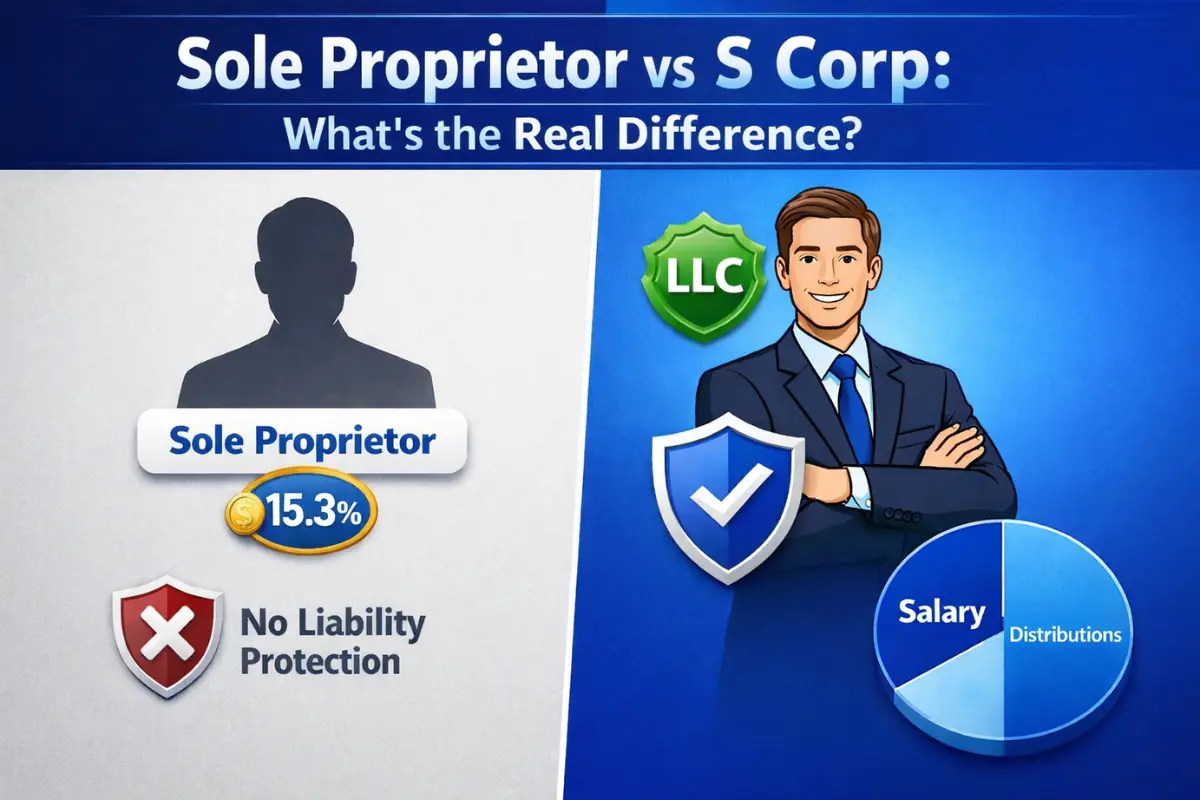
- Sole proprietors pay self-employment tax on 100% of their net profits, while S Corp owners only pay it on their salary.
- S Corps offer personal liability protection; sole proprietorships do not.
- Converting from sole proprietor to S Corp makes financial sense once your net profit consistently exceeds $50,000.
- S Corps require more administrative upkeep, including payroll and annual filings.
What Is a Sole Proprietor?
According to the IRS, “A sole proprietor is someone who owns an unincorporated business by himself or herself.” In plain terms, it’s the simplest way to run a business. There’s no paperwork to file, no separation between you and the company, you just start doing business and report the income on your personal tax return.
It’s the default structure for freelancers, consultants, and small business owners who haven’t formally registered a business entity. The simplicity is appealing, but it comes with some serious trade-offs.
Running your business as a sole proprietor is a bit like driving without insurance. Everything works smoothly, until it doesn’t. The moment a client dispute turns into a lawsuit or business debt gets out of hand, your personal assets are on the line. No legal barrier, no protection, just you.
What Is an S Corporation?
The IRS defines it this way: “S corporations are corporations that elect to pass corporate income, losses, deductions, and credits through to their shareholders for federal tax purposes.” Unlike a C Corp, an S Corp avoids double taxation. Income passes directly to the owners’ personal returns.
An S Corp isn’t a separate business entity in the way an LLC or C Corp is, it’s a tax election. Many business owners form an LLC first, then elect S Corp tax treatment to capture the tax benefits while keeping the operational simplicity of an LLC structure.
One important nuance: the IRS requires S Corp owners who work in the business to pay themselves a “reasonable salary.” That salary is subject to payroll taxes, but any additional profits taken as distributions are not. That split is where the tax savings come from, and it’s the core reason so many growing businesses make the switch.
Is an S Corp a Sole Proprietor?
No, and this is a common point of confusion. A sole proprietorship has no formal legal structure, while an S Corp is a recognized tax election that comes with legal formation requirements, governance rules, and payroll obligations. They are fundamentally different in how the IRS treats your income and how the law treats your personal assets.
Difference Between S Corp and Sole Proprietor
Here’s a quick look at how the two structures compare across the areas that matter most to business owners:
| Feature | Sole Proprietor | S Corporation |
|---|---|---|
| Liability Protection | None — personal assets at risk High Risk | Limited — personal assets protected Protected |
| Taxation | Self-employment tax on all profits | Salary + distributions (tax savings) Save More |
| Self-Employment Tax | 15.3% on all net earnings Full Rate | Only on reasonable salary |
| Formation Cost | None | State filing fees + S Corp election |
| Complexity | Very low | Moderate (payroll required) |
| Best For | Part-time / early-stage businesses | Profitable businesses ($50K+ net) Recommended |
This table is for general informational purposes only and does not constitute legal or tax advice.
Liability Protection
As a sole proprietor, you and your business are legally the same entity. If a client sues your business or a vendor comes after you for an unpaid debt, your personal bank account, home, and savings are all fair game.
An S Corp (typically structured as an LLC with an S Corp election) creates a legal separation between you and the business. Your personal assets stay protected from business liabilities, a critical advantage as your business grows.
Ownership Structure
A sole proprietorship has one owner, you. An S Corp can have up to 100 shareholders, but they must all be U.S. citizens or residents. This makes S Corps a solid choice for small, closely held businesses, but not ideal for companies planning to bring in foreign investors.
Management Requirements
Sole proprietors make every decision themselves with no formalities required. S Corps, on the other hand, require payroll for owner-employees, annual filings, and more administrative oversight. It’s more work, but the financial payoff often justifies it.
S Corp vs Sole Proprietor Taxes
Self-Employment Tax: S Corp vs Sole Proprietor
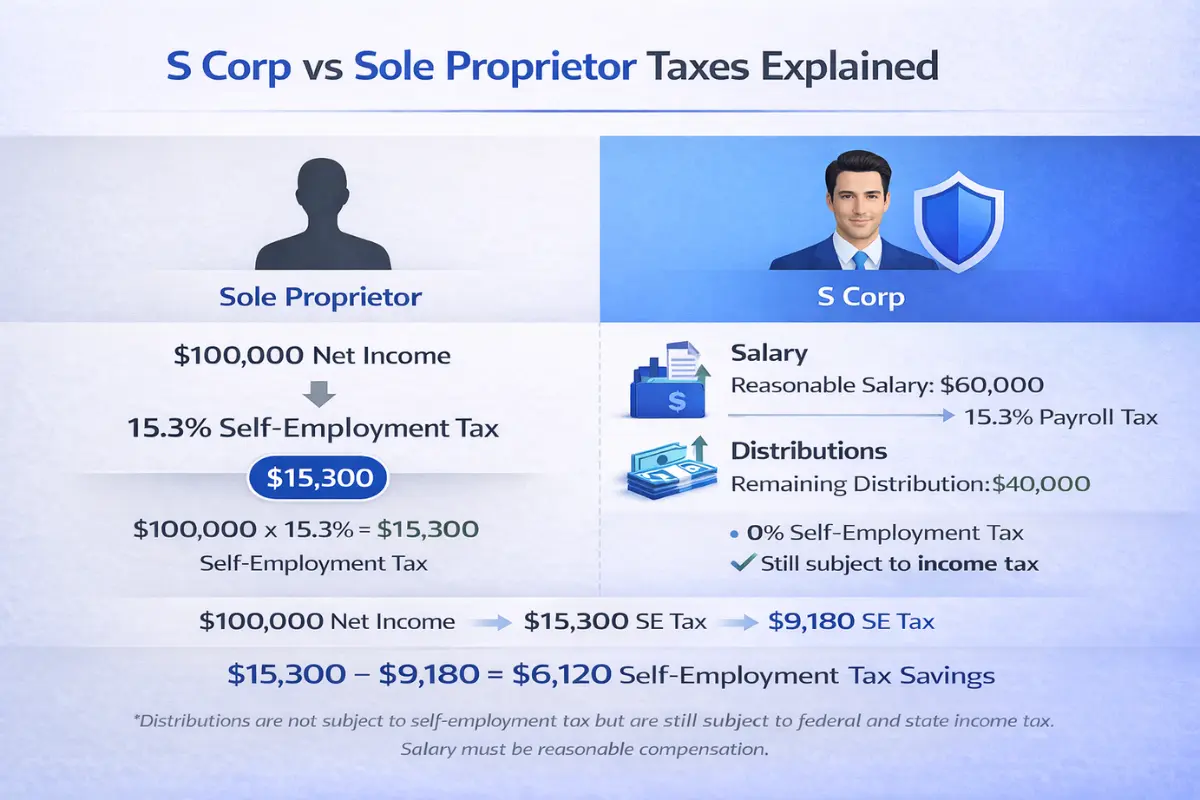
Most sole proprietors don’t realize how much self-employment tax is quietly cutting into their income. The self-employment tax rate is 15.3%, and as a sole proprietor, you pay that on every dollar of net profit. Earn $100,000 and you owe $15,300 in self-employment taxes alone, before federal and state income taxes even enter the picture.
With an S Corp, that changes. You divide your income into two parts: a reasonable salary, subject to payroll taxes, and distributions, which are not subject to self-employment tax. That one structural difference can translate into thousands of dollars back in your pocket each year.
S Corp vs Sole Proprietor Tax Savings
Let’s make this concrete. Say your business nets $120,000 annually. As a sole proprietor, you’d owe self-employment tax on all of it. As an S Corp owner, if you pay yourself a $60,000 salary, you only pay payroll taxes on that portion. The remaining $60,000 in distributions avoids self-employment tax, saving you roughly $9,180 per year.
Scale that up to $150,000 in net profit, and the savings grow even further. That’s real money, money that could go toward hiring your first employee, investing back into the business, or simply staying in your pocket where it belongs.
Those savings don’t happen automatically, you’ll need to factor in payroll processing costs and accounting fees. But for most profitable businesses, the math works out strongly in favor of the S Corp election. Most CPAs who work with small business owners will tell you the S Corp election is one of the single best tax moves available to self-employed individuals once income reaches a certain threshold.
FAQs
No. A sole proprietorship has no formal legal structure and offers no liability protection. An S Corp is a tax election applied to a legally formed entity, and it comes with personal liability protection and different tax treatment.
In most cases, yes, particularly on self-employment taxes. By splitting income between salary and distributions, S Corp owners typically avoid paying the full 15.3% self-employment tax on all their profits. The savings can be substantial for businesses netting $50,000 or more annually.
Most tax professionals recommend considering the switch once your net business income consistently exceeds $50,000 per year. At that level, the tax savings typically outweigh the costs of maintaining payroll and meeting S Corp compliance requirements.
Yes. S Corp owners who work in the business must pay themselves a "reasonable salary" subject to payroll taxes. This is a key IRS requirement, and skipping it can trigger an audit. Working with a payroll provider or accountant helps ensure you're meeting this obligation correctly.
No. As a sole proprietor, you and your business are the same legal entity, so your personal assets—like your savings, home, and car—are fully at risk if the business faces a lawsuit or debt. There's no liability protection. Forming an LLC or electing S Corp status creates that legal separation and protects your personal assets.
Yes. A single-member LLC is taxed like a sole proprietor by default, but by filing IRS Form 2553, it can elect S Corp status and benefit from the salary-and-distributions tax treatment. This provides the liability protection of an LLC and the tax savings of an S Corp without creating a new legal entity.
As a sole proprietor, all business income is reported on your personal tax return and subject to both income and self-employment taxes. With an S Corp, profits still pass through to your personal return, but only your salary is subject to employment taxes. The rest, paid as distributions, is taxed as income only—creating significant potential savings.
Yes. While S Corp status can offer significant tax savings, it also means more administrative work. You must run payroll, keep corporate records, and file a separate tax return. The IRS also requires owners to pay themselves a reasonable salary, which can draw scrutiny if overlooked. For lower-profit businesses, these extra costs can outweigh the benefits, so it's wise to consult a tax professional first.
Yes. Sole proprietors report expenses on Schedule C of their personal tax return, while an S Corp files its own return (Form 1120-S) and deducts expenses at the corporate level before profits pass through. This setup improves recordkeeping and may offer more deductions but requires more detailed and organized filings.
Disclaimer: This content is intended for general educational and informational purposes only and does not constitute legal, tax, or accounting advice. Every effort is made to keep the information current and accurate; however, laws, regulations, and guidance can change, and no representation or warranty is given that the content is complete, up to date, or suitable for any particular situation. You should not rely on this material as a substitute for advice from a qualified professional who can consider your specific facts and objectives before you make decisions or take action.