

The Key Differences: LLC Agreement vs Operating Agreement Explained
You filed your LLC paperwork and felt accomplished, then someone mentions your “operating agreement.” Suddenly you are wondering if you missed something critical. Or maybe you have seen both “LLC agreement” and “operating agreement” and are not sure if they are the same thing.
Confusion around these terms causes real problems. Some LLC owners skip essential documents; others waste money on duplicates.
We’re clearing up this confusion once and for all, showing you exactly which documents matter and why.

Key Takeaways
The terms “LLC agreement” and “operating agreement” usually refer to the same document, your LLC’s internal rulebook.
An operating agreement outlines ownership structure, member rights, profit distribution, and management procedures for your LLC.
While not always legally required, an operating agreement protects your liability shield and prevents costly disputes between members.
DoMyLLC helps you create comprehensive operating agreements that protect your business and keep you in compliance with state requirements.
What is an LLC Agreement?
Definition and Purpose
An LLC agreement, also called an operating agreement, is the internal contract that governs how a limited liability company is owned, managed, and run. It sets out members’ rights and obligations and explains how decisions are made and how company affairs are handled. Without an LLC agreement, the company is generally governed by default state rules, which may not match what the owners want.
What is an Operating Agreement?
Definition and Purpose
According to the U.S. Small Business Administration, “An operating agreement is a key document used by LLCs because it outlines the business’ financial and functional decisions including rules, regulations and provisions.” This document is generally not filed with the state; it is an internal contract among the LLC members that governs how the company is owned, managed, and operated. A written operating agreement also helps show that the LLC is a separate legal entity from its owners, which supports limited liability protection when combined with good practices like separating personal and business finances and properly capitalizing the business.
Key Components These Agreements Cover
Because “LLC agreement” and “operating agreement” are two names for the same document, they typically address the same topics, including:
- Who the members are, their ownership percentages, and their capital contributions.
- How the LLC is managed (member‑managed or manager‑managed) and who has authority to act for the company.
- How voting works, what matters require approval, and what voting thresholds apply.
- How profits and losses are allocated and when and how distributions are made.
- How membership interests can be transferred and any consent or buyout requirements.
- When and how the LLC may be dissolved and how remaining assets and obligations are handled.
LLC Agreement vs Operating Agreement
Key Differences
“LLC agreement” and “operating agreement” are commonly used to describe the same internal contract that governs an LLC’s ownership, management, and operations. In some states, such as Delaware, “limited liability company agreement” is the statutory term, while “operating agreement” is the more widely used practical term, but they serve the same function as the LLC’s governance document. To form and govern an LLC you typically use two core documents: the Articles of Organization (or Certificate of Formation), which are filed with the state to create the LLC, and an operating agreement/LLC agreement, which is kept internally to set the rules among the owners. Other documents (such as licenses, tax registrations, or an EIN) may also be required depending on the state and type of business.
Do I Need an Operating Agreement for My LLC?
Legal Requirements
Whether an operating agreement is legally required depends on the state’s LLC statute. States including California, Delaware, Maine, Missouri, and New York require LLCs to have an operating agreement, and in some of these states it may be written, oral, or implied rather than a formal written document. Even where not expressly required, many advisors recommend having a written operating agreement because banks and investors often request it, and courts may review it when determining whether to treat the LLC as a separate legal entity.
Benefits of Having an Operating Agreement
Key Benefits
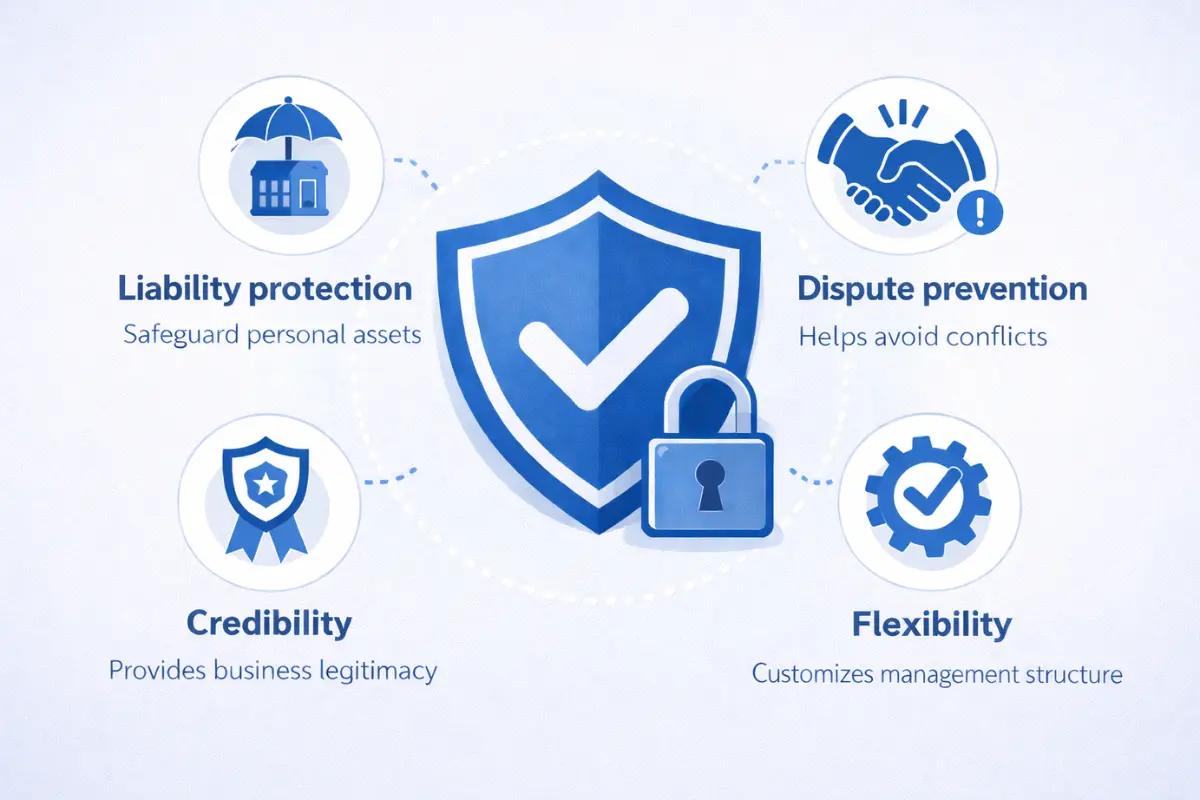
Liability protection: Helps demonstrate that the LLC is operated as a separate legal entity, supporting limited liability and reducing the risk of personal liability for business debts.
Dispute prevention: Establishes clear rules and procedures, which can reduce misunderstandings and conflicts among members.
Operational clarity: Defines management structure, roles, decision‑making authority, and processes for major and routine business actions.
Credibility: Lenders, investors, and other counterparties commonly expect to see an operating agreement before doing business with the LLC.
Flexibility: Allows members to customize economic terms, management rights, and procedures instead of relying solely on default state rules.
Succession planning: Provides procedures for events such as a member’s death, disability, or exit and for transfers of ownership interests.
Single‑member LLCs also benefit from having a written operating agreement, because it helps document that the business is distinct from the owner and supports limited liability and continuity planning.
Common Misconceptions
Several myths cause LLC owners to overlook operating agreements:
- State law is enough. State default rules are only a minimum; a tailored agreement lets you set clearer, business‑specific expectations.
- Only multi‑member LLCs need one. Single‑member LLCs especially benefit, because a written agreement helps show the business is separate from the owner.
- Free templates are fine for everyone. Generic forms often ignore state‑specific rules and your actual ownership, management, and payout structure.
- You draft it once and never touch it. Your agreement should be reviewed and updated as your ownership, management, or business model changes.
Partner With Us to Launch Your LLC on Solid Ground
We specialize in LLC formation and help you create an operating agreement tailored to your business needs. Haven’t registered your LLC yet? We can take care of the entire formation process for you. DoMyLLC also offers registered agent services and ongoing compliance support to help you keep your company in good standing with state agencies.
Your limited liability company deserves a solid operating agreement that protects your interests and clarifies how your business runs. This critical legal document delivers the protection, structure, and professional credibility your LLC needs to succeed.
Contact us today to protect your business with an LLC that’s structured correctly.
FAQs
Technically yes, but it's risky. Operating agreements require legal language and state-specific provisions that templates miss. Poor agreements can create more problems than having none.
Your LLC defaults to state laws that might not match your intentions. You risk weakening liability protection, facing bank account obstacles, appearing unprofessional to investors, and creating opportunities for member disputes.
DIY templates run free to $100 but miss crucial provisions. Attorney-drafted agreements cost $500-$2,000+.
Absolutely. Courts more readily pierce the corporate veil for single-member LLCs lacking proper documentation. Operating agreements prove separate entity status, establish procedures for adding members, and satisfy bank requirements.
Yes. Most agreements include amendment procedures with specific voting thresholds. Update when adding members, changing ownership, or modifying management. Follow existing procedures and provide updated copies to all members.
While some states allow verbal agreements between LLC members, a written operating agreement provides crucial legal protection that verbal agreements cannot. Verbal agreements are difficult to prove in court, create confusion about actual terms, and fail to demonstrate your LLC's legitimacy to banks and investors. Most states require LLCs to have written documentation, and financial institutions typically won't open bank accounts without seeing a formal written operating agreement. A well-drafted operating agreement protects all members by clearly documenting ownership percentages, management structure, voting rights, and procedures, preventing disputes that often arise from verbal understandings.
Yes. Without an operating agreement, your limited liability company automatically operates under your state's default provisions and default rules. These one-size-fits-all regulations may not align with how you actually want to run your business affairs. State default rules typically mandate equal profit distribution regardless of capital contributions, require unanimous consent for major decisions, and may not address succession planning when members leave. Many business owners discover too late that their state's default rules do not match their intentions, causing legal problems and disputes between members. Creating a written operating agreement lets you customize these rules to fit your specific business structure and goals.
How new members join your LLC and what happens to existing membership interests depends entirely on what your operating agreement specifies. Without clear operating procedures in your agreement, adding new members can create serious complications. A well-drafted operating agreement should address admission requirements for new members, whether existing LLC members have first refusal rights, how new membership interests affect current ownership percentages, what capital contributions are required, and voting rights for incoming members. Multi-member LLCs particularly need these provisions to prevent disputes. If your agreement is silent on these issues, you'll default to state law, which may require unanimous consent from all other members before admitting anyone new.
Operating agreement templates provide basic information and standard provisions, but they rarely offer the same limited liability protection as a custom agreement tailored to your specific situation. Generic templates often miss state-specific requirements that could jeopardize your LLC's legal standing. They typically don't address your unique management structure, whether you're member-managed or manager-managed, or special arrangements between LLC owners. Templates also frequently overlook key elements like buy-sell provisions, dispute resolution procedures, and succession planning. While templates might work for a straightforward single-member LLC, multi-member LLCs and businesses with complex ownership structures need custom agreements. Many LLCs formed with template agreements later face legal trouble because the documents don't actually protect their interests or comply with their state law requirements.
These are three distinct legal documents serving different purposes. Articles of organization are the public formation documents you file with your state to legally create your LLC. They include basic information like your legal name, principal place of business, and registered agent. This is a required document for LLC formation. An operating agreement is an internal document that governs how your LLC operates, is not filed publicly, and contains detailed provisions about management, profits, member duties, and procedures. A shareholders agreement, by contrast, applies to corporations, not LLCs. While both operating agreements and shareholders agreement serve similar governance purposes for their respective business structures (LLCs versus corporations), the terminology and certain terms differ. LLCs have members and membership interests, while corporations have shareholders and stock. For tax purposes and limited liability protection, these distinctions matter significantly.
Disclaimer: This content is intended for general educational and informational purposes only and does not constitute legal, tax, or accounting advice. Every effort is made to keep the information current and accurate; however, laws, regulations, and guidance can change, and no representation or warranty is given that the content is complete, up to date, or suitable for any particular situation. You should not rely on this material as a substitute for advice from a qualified professional who can consider your specific facts and objectives before you make decisions or take action.