

What Is an Annual Report in 2026?
What if missing one simple filing could cost you your business?
An annual report is a required state filing that helps keep your LLC or corporation in good standing and legally active. It is not a glossy investor document; it is a compliance form used to confirm or update your business information on file with the state government.
Annual reports still matter for businesses in 2026 because many states require them to maintain an entity’s legal status. If you do not file on time, you can face late fees, loss of good standing, and, in some states, eventual administrative dissolution of your company.
This guide focuses on state level compliance filings, not investor focused annual reports or financial statements, and explains how state annual reports update key details such as your business address, registered agent, and ownership or management information with the Secretary of State or equivalent agency, while also covering which entities must file, how due dates typically work, and practical steps to stay compliant.

Key Takeaways
- Annual reports are mandatory state compliance filings that update your business information with the Secretary of State, not investor documents or tax returns.
- Most LLCs and corporations must file annual or biennial reports to maintain good standing, with requirements varying by state and entity type.
- Filing deadlines differ by state—some use fixed calendar dates while others use anniversary-based schedules tied to your formation date.
- Missing annual report deadlines can result in late fees, loss of good standing, inability to conduct business legally, and eventual administrative dissolution.
- Annual reports typically include your legal business name, principal address, registered agent details, and information about members, managers, directors, or officers.
- Multi-state businesses must file separate annual reports in each state where they’re registered, each with different deadlines and fees.
- Reinstatement after administrative dissolution requires filing all missing reports, paying accumulated fees and penalties, plus a reinstatement fee—often totaling hundreds of dollars.
- Stay compliant by setting up calendar reminders 60 and 30 days before deadlines, keeping business information current, and considering professional compliance services for multi-state operations.
What Is an LLC Annual Report?
An annual report is an official state filing used to confirm or update your company’s key information with the state where you are registered. According to the U.S. Chamber of Commerce, annual reports “allow states to keep their databases updated with current business information.”
States require these reports so public records stay accurate for anyone who needs to verify that a business exists and is in good standing, including clients, vendors, and lenders. The filing typically updates items such as your business address, registered agent, and management or ownership details, depending on state rules.
Both LLCs and corporations generally must file these reports, though the exact details requested can differ by entity type and state. Some states use different names—such as “statement of information” or “periodic report”—for filings that serve the same basic compliance purpose.
Many business owners mistakenly think they can skip annual reports if nothing has changed, assume they are the same as tax returns, or believe they only apply to large corporations. In reality, most small LLCs and closely held corporations must file on a regular schedule to stay in good standing and avoid penalties or even administrative dissolution.
What Is the Purpose of an Annual Report?
Maintaining accurate public business records is the primary purpose. When your business address, registered agent, or ownership changes, the annual report updates these details in the state’s official database.
Verifying ownership and management information helps states track who’s legally responsible for each business. If legal notices need to be served or regulatory issues occur, the state needs to know who’s running the business.
Supporting business entity good standing is crucial for business owners. According to SCORE, maintaining good standing through annual reports is essential because “it affects your ability to get loans, enter contracts, and conduct business legally”.
How annual reports impact multi-state compliance: Each state where you’re registered requires its own annual report. If your Delaware LLC also does business in California and Texas, you’ll file three separate reports with different deadlines.
Who Is Required to File an Annual Report?
In most states, LLCs and corporations must file an annual or periodic report, whether they are formed in that state or registered there as foreign entities. This generally applies to both C corporations and S corporations and often includes reporting directors, officers, and other key details.
Nonprofit corporations are also frequently required to file periodic reports to maintain good standing, though forms and schedules may be simpler or different. If your business is registered in more than one state, you typically have a separate reporting obligation, deadline, and fee in each jurisdiction.
Rules are not identical everywhere. A few states do not require LLC reports, while others use biennial or even decennial filing schedules, so it is important to check current requirements in each state where your business is registered.
What Information Is Included in an Annual Business Report?
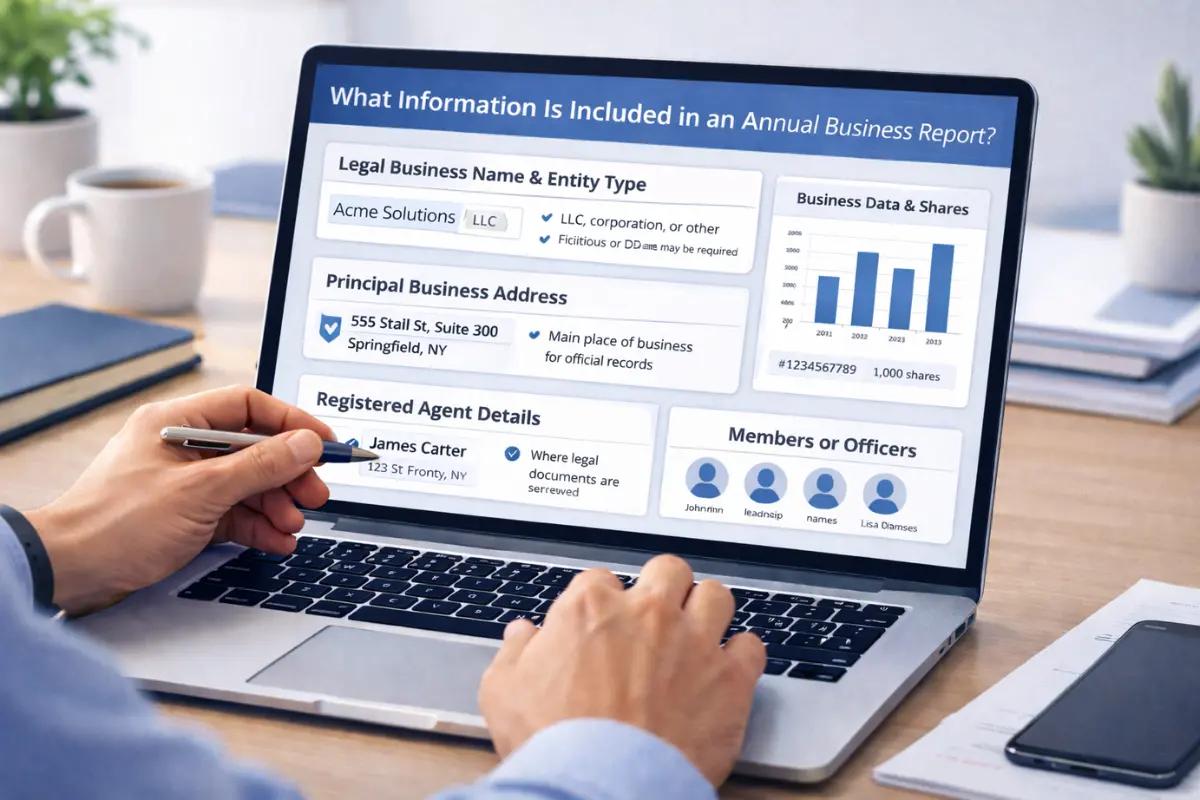
Legal business name and entity type are almost always required so the state can confirm your exact legal name and whether you are an LLC, corporation, or another registered entity; some states also ask for fictitious or DBA names, especially for foreign entities.
Principal business address is typically your main place of business or primary office, not just your registered agent’s address, and is used for official records and correspondence.
Registered agent details must be current, including the registered agent’s name and physical street address in the state, because this is where legal documents and official notices are served.
Information about members, managers, directors, or officers varies by entity type and state: LLC reports commonly list the names and business addresses of members or managers, while corporate reports usually list officers and directors and their business addresses. Beyond these basics, state‑specific data requirements can include items such as business purpose descriptions, identification numbers, or other contact details, and some jurisdictions (like Delaware for corporations) also require information related to authorized shares as part of their annual reporting and franchise tax framework.
When Is an Annual Report Due in 2026?
Typical filing schedules fall into two main patterns: some states use fixed calendar due dates for all entities, while others use anniversary‑based deadlines tied to the month or date your business was formed or registered. Deadlines can also differ by entity type within the same state, so corporations and LLCs in one state may follow separate schedules.
LLC deadlines vary by state. Delaware LLCs do not file an annual report but must pay an annual franchise tax by June 1 to stay in good standing, while Nevada LLCs file an Annual List by the last day of their anniversary month (for example, a March 15 formation renews by March 31).
Corporate deadlines can differ from LLC rules in the same state. Delaware corporations file an annual report and pay franchise tax by March 1, and Nevada corporations, like Nevada LLCs, file an Annual List due the last day of the anniversary month, with different fees and late‑fee structures.
Several states use biennial rather than annual reporting schedules, sometimes varying by entity type. For instance, some states require LLC or corporate biennial reports that are due in specific months of odd or even years, which can make them easier to overlook without a tracking system.
Late fees and penalty timelines escalate quickly. Most states charge penalties starting the day after your deadline. Some impose administrative dissolution after 60-90 days of delinquency. Late fees can reach hundreds of dollars beyond your original filing fee.
How to File an Annual Report
Filing Online Through the State
Where filings are submitted: Each state maintains its own portal through the Secretary of State website. Search “[Your State] Secretary of State business filings” to find your official portal. Avoid third-party websites charging excessive fees.
What to prepare before filing: your entity number, current business information, registered agent details, and payment method. Most states accept credit cards or electronic checks.
Filing by Mail (Where Available)
When mail filing still applies: Some states still accept paper annual reports, though mandatory electronic filing is becoming standard. You’ll download the form, complete it, and mail it with payment.
Processing time considerations: Paper submissions can take weeks, while online filings process within 24-48 hours with immediate confirmation.
Using a Business Compliance Service
When professional help makes sense: operating in multiple states, managing several entities, lacking time to track deadlines, or wanting peace of mind about compliance.
Benefits for growing or multi‑state businesses: We track each state’s requirements, send deadline reminders, file reports on your behalf, and help maintain your good standing so you can focus on running your business.
Annual Report vs. Tax Filing (Important Difference)
Why annual reports are not tax returns: Annual reports update your business information with your state. Tax returns report your income and expenses to the IRS and state tax departments. They serve different purposes and go to different agencies.
State vs federal filing responsibilities: Your annual report goes to your Secretary of State and costs $50-$500. Your tax return goes to the IRS for federal taxes and your state’s revenue department for state taxes. They report different information with different deadlines.
Common mistakes that lead to missed annual report deadlines include assuming that filing tax returns satisfies all obligations or believing an accountant automatically handles every state compliance task. Many accountants focus on preparing and filing tax returns, while annual report compliance is often left to the owner or a separate registered agent or compliance service.
Annual Report vs. Other State Compliance Filings
Annual report vs statement of information: These terms usually describe the same type of state‑level compliance filing, with different labels depending on the jurisdiction. In California, for example, the required “Statement of Information” serves the same core purpose as an annual report in other states by updating business addresses, management, and registered agent details.
Annual report vs franchise tax filing: Franchise tax is a tax some states charge for doing business there. Delaware combines your annual report and franchise tax into one filing. California keeps them separate with different forms and deadlines.
Annual report vs biennial report: Biennial reports are annual reports filed every two years instead of annually. Ohio and New York require biennial reports for LLCs. The information is the same; you just file less frequently.
What Happens If You Don’t File an Annual Report?
Late fees and penalties start immediately after your deadline. Most states charge $25-$100 initially, with escalating penalties. A $50 annual report can become $200+ if you’re several months late.
Loss of good standing is a common consequence of delinquency and can limit your ability to maintain lawsuits, obtain certain licenses, or secure financing, since lenders and partners often review good standing status before doing business. If noncompliance continues, many states may move to administrative dissolution or revocation, at which point the entity is no longer recognized as active and may lose rights to its name and other protections.
Reinstatement usually requires filing missing reports and paying all back fees, penalties, and a reinstatement fee, with total costs frequently reaching hundreds of dollars or more depending on how long the entity has been inactive. The reinstatement process can take from several days to weeks or longer, and until it is completed, the company may face restrictions on doing business or proving its legal status.
How to Stay Compliant With Annual Reports Year After Year
Staying compliant with annual reports year after year comes down to organized tracking and timely updates.
- Use a centralized system (calendar, spreadsheet, or compliance software) to list each entity, state, filing frequency, and due date, and set reminders well in advance (for example, 60 and 30 days before each deadline).
- Update key business information promptly, such as addresses, registered agents, or management, so state records stay current and you are not scrambling to correct details at filing time.
- For multi‑state or multi‑entity operations, maintain organized records of requirements, deadlines, and filing confirmations, and consider using compliance services or professionals to reduce the risk of missed reports.
Simplifying Annual Report Filing With Professional Compliance Support
Tracking annual report deadlines becomes increasingly complex as a business expands into multiple states, each with its own systems, forms, and due dates. Missteps in filing, such as incorrect registered agent information or outdated ownership details, can lead to missed legal notices and potential challenges to your company’s legal protections.
DoMyLLC offers comprehensive annual report services for businesses operating in one or many jurisdictions. The team monitors deadlines, maintains registered agent details, prepares and submits required filings, and manages multi‑state compliance so your entities remain in good standing. Contact DoMyLLC today to ensure your annual report obligations are handled accurately and on time.
Frequently Asked Questions About Annual Reports
Initial reports are filed when you first register your business entity with the state, typically within a specific timeframe after formation. Annual report filings are ongoing compliance requirements you submit every year (or biennially in some states) to keep your business in good standing. While initial reports establish your business's baseline information, annual reports update that information over time to reflect any changes in your registered office address, members, managers, directors, officers, or other entity information.
Yes. If your LLC fails to file annual reports and becomes administratively dissolved, you can lose your limited liability protection. Administrative dissolution means your business entity no longer legally exists in the state's records, which can expose members to personal liability for business debts and obligations. Most states require limited liability companies to maintain compliance with filing requirements and pay applicable fees to preserve their active status and the legal protections that come with it.
Biennial reports are essentially the same as annual reports but filed every two years instead of annually. They contain similar entity information including your registered agent, registered office address, members or officers, and company records. States that use biennial reporting include Ohio, New York, and several others. The less frequent filing schedule means small business owners need to track carefully, because if you filed a biennial statement in 2024, your next due date is not until 2026, making it easier to overlook without proper calendar reminders.
When your business faces administrative dissolution for failure to file annual reports or pay required fees, any membership interest transfers in LLCs or stock transfers in corporations may lack legal effect. The entity's administratively dissolved status means it cannot legally conduct business transactions, including issuing membership shares or transferring ownership interests. You'll need to pay a reinstatement fee and file all overdue annual report filings to restore your business to good standing before legitimate ownership transfers can occur. Most states require you to hold annual meetings and maintain proper meeting minutes documenting such transfers, but these actions have limited legal standing if your entity isn't in active status.
Nonprofit corporations typically must file annual reports to maintain their good standing, though some states offer simplified forms or different due dates compared to for-profit entities. Limited partnerships also face annual report requirements in most states, with filing requirements often including information about general and limited partners. Both entity types must maintain a registered agent and registered office address, file reports by their specified due date (often based on the calendar year or anniversary of formation), and comply with their state's specific internal requirements. Small businesses operating as nonprofits or limited partnerships should verify their state's filing requirements, as some states set different standards for these entities compared to limited liability companies and corporations.
Disclaimer: This content is intended for general educational and informational purposes only and does not constitute legal, tax, or accounting advice. Every effort is made to keep the information current and accurate; however, laws, regulations, and guidance can change, and no representation or warranty is given that the content is complete, up to date, or suitable for any particular situation. You should not rely on this material as a substitute for advice from a qualified professional who can consider your specific facts and objectives before you make decisions or take action.