

DBA vs LLC: What’s the Difference?
What if choosing the wrong business structure could cost you everything you’ve built, including your savings, your home, and your family’s financial security?
Most new business owners think picking between a DBA and an LLC is just about paperwork. But this decision affects how much you pay in taxes, whether your personal assets are protected from lawsuits, and how professional your business appears to clients.
DoMyLLC created this comprehensive guide to help you understand the key differences between these two business structures. It outlines what each option offers, the related costs, and when each may be the right fit for your needs. By the end, you’ll have the insight to make an informed decision that protects your interests and helps keep your business compliant.
Key Takeaways
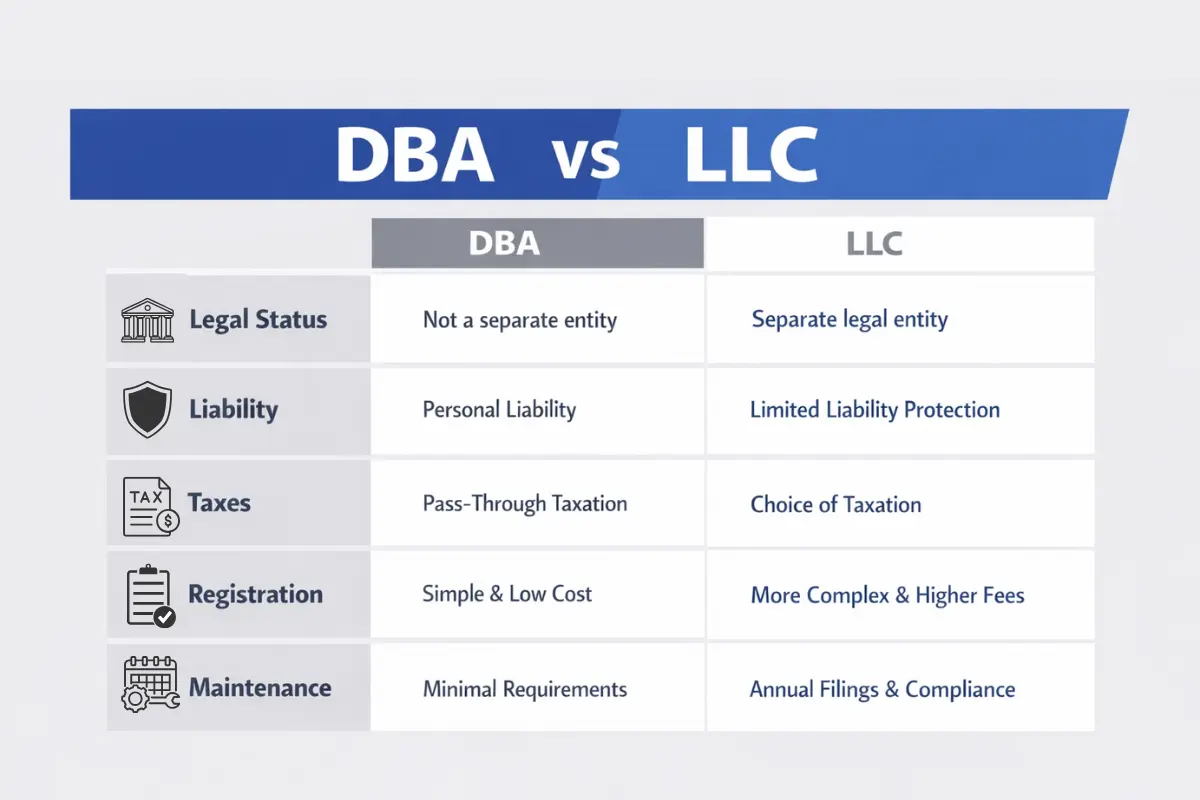
- A DBA is just a business name. It doesn’t create legal separation between you and your business, leaving your personal assets exposed to business liabilities.
- An LLC creates a separate legal entity that protects your personal assets from most business debts and lawsuits.
- DBA vs LLC cost differences are significant: DBAs typically cost $10-$100 to register, while LLCs range from $50-$500 depending on your state.
- Tax treatment differs: DBAs don’t change your tax situation, while LLCs offer flexible tax options that could save you thousands annually.
- The right choice depends on your risk level, growth plans, and how much liability protection you need.
Understanding DBA
What is a DBA?
A DBA—”Doing Business As”—is a registered business name that lets you operate under something other than your legal name. Think of it as a nickname for your business rather than a separate legal identity.
According to the U.S. Small Business Administration, “You might need to register your DBA — also known as a trade name, fictitious name, or assumed name — with the state, county, or city your business is located in.”
Here’s what’s critical: a DBA doesn’t create a separate business entity. You’re still operating as yourself, just under a different name. There’s no legal barrier between you and your business activities.
Benefits of a DBA
DBAs can be a practical option for new entrepreneurs who want to test a business concept with minimal upfront cost. They allow you to operate under a branded business name without forming a separate legal entity such as an LLC. In many areas, the registration process is relatively simple: you file the required paperwork with your local or state office (often the county clerk), pay a modest filing fee, and complete any publication or notice requirements if applicable.
Most banks require a DBA to open a business bank account under a name different from your personal name. You can register multiple DBAs for different product lines, and renewal costs are minimal.
Limitations of a DBA
The simplicity of a DBA comes with serious drawbacks. The biggest risk is zero personal liability protection. As Forbes Advisor explains, “Registering a DBA does not create a separate legal entity. This means the business owner remains personally liable for all debts and obligations of the business.” If someone sues your business, creditors can come after your house, car, and savings.
A DBA doesn’t change your tax situation. You still report business income on your personal tax return with no opportunity for tax optimization. Getting funding as a sole proprietor is also significantly more challenging than with an LLC structure.
Understanding LLC
What is an LLC?
A Limited Liability Company (LLC) is a formal business structure that creates a separate legal entity distinct from its owners. When you form an LLC, you’re building a legal wall between yourself and your business.
The U.S. Small Business Administration notes that “LLCs protect you from personal liability in most instances, your personal assets — like your vehicle, house, and savings accounts — won’t be at risk in case your LLC faces bankruptcy or lawsuits.”
LLCs combine the liability protection of corporations with the tax flexibility and operational simplicity of partnerships, making them the preferred choice for most established small businesses. When you’re ready to form an LLC, working with experienced professionals like DoMyLLC, helps you set up your business correctly from day one.
Benefits of an LLC
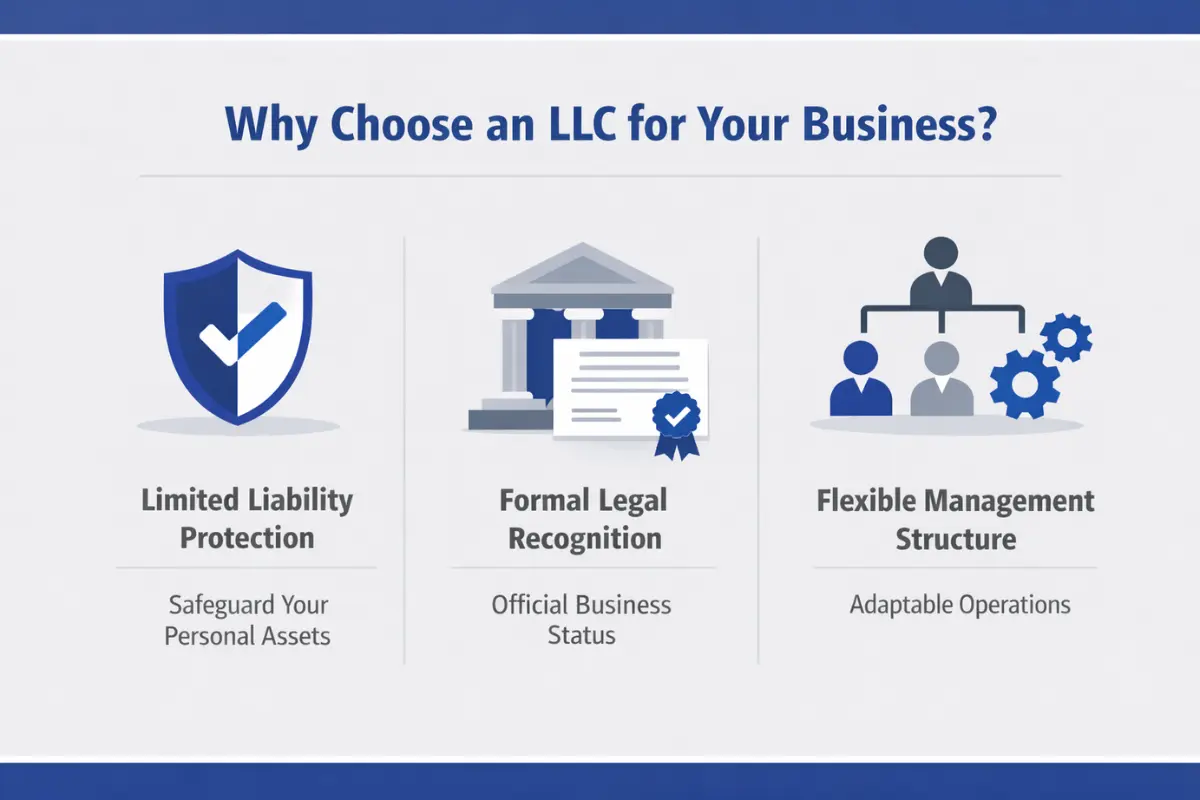
When properly maintained, an LLC shields your personal assets from business liabilities. Business debts stay with the business, and lawsuits target the LLC, not your personal assets.
LLCs provide tax flexibility. By default, single-member LLCs are taxed as sole proprietorships. But you can elect S-Corporation or C-Corporation tax status to optimize your tax strategy as your business grows. Having “LLC” after your business name signals professionalism, makes it easier to bring in investors, and doesn’t require complex governance like corporations do.
Limitations of an LLC
Creating an LLC costs more upfront than registering a DBA, with state filing fees ranging from $50 to $500. Most states require annual reports and fees to keep your LLC in good standing. Unless you elect S-Corporation tax status, LLC members typically pay self-employment taxes on all business profits.
DBA vs LLC Comparison
DBA vs LLC Cost
Cost differences between a DBA vs LLC can be significant when you factor in both initial and ongoing expenses.
DBA costs: Initial registration runs $10-$100 (varies by county/state), plus $50-$200 for publication requirements in some states. Renewal costs $10-$100 every 1-5 years. Total first-year cost is approximately $60-$300.
LLC costs: Articles of Organization filing costs $50-$500 (state-dependent), registered agent fees run $0-$300 annually, and annual report/franchise taxes range from $0-$800 annually. Total first-year cost is approximately $100-$1,600.
The DBA vs LLC cost comparison shows DBAs as the budget option. However, a single business lawsuit without liability protection could cost tens of thousands of dollars, or even everything you own. The few hundred dollars’ difference suddenly seems insignificant.
DBA vs LLC Taxes
Tax treatment represents one of the most important differences in the DBA vs LLC decision.
DBA taxes: A DBA doesn’t change your tax situation. You’re still taxed as a sole proprietor with all business income flowing through to your personal tax return. You’ll pay income tax on all profits plus 15.3% self-employment tax on all net business income, with no tax optimization opportunities.
LLC taxes: LLCs offer flexibility. By default, taxation mirrors sole proprietorships or partnerships. However, LLCs can elect S-Corporation status for potential self-employment tax savings by splitting income between salary and distributions, or C-Corporation tax status in specific situations.
For example, if your business generates $100,000 in profit, you’d pay approximately $15,300 in self-employment taxes as a sole proprietor with a DBA. With an S-Corp election, you might save around $6,000 annually.
Pros and Cons of DBA vs LLC
Understanding the pros and cons of DBA vs LLC helps you evaluate which structure aligns with your business goals and risk tolerance.
DBA Pros: Extremely low cost ($10-$100), fast and simple registration, minimal ongoing compliance, allows professional business name, and you can register multiple DBAs easily.
DBA Cons: Zero personal liability protection, no tax benefits or optimization options, less credibility with clients and lenders, difficult to raise capital, and limited name protection.
LLC Pros: Strong personal liability protection, flexible tax treatment options, enhanced professional credibility, easier to attract investors, business continuity beyond owner, and you can still use DBAs for multiple brands.
LLC Cons: Higher formation costs ($100-$500+), annual compliance requirements, more complex bookkeeping, state-specific regulations, and potential self-employment tax on all profits without S-Corp election.
Consider both your current situation and future plans. What works for a $10,000 side hustle may be inadequate for a $100,000 growing business.
Choosing Between DBA and LLC
Factors to Consider
Making the right choice between a DBA vs LLC requires honest evaluation of several key factors.
Consider your risk and liability exposure. Service businesses with direct client interaction face higher liability than low-risk online ventures. Evaluate your personal assets at stake. The more you have to lose, the more critical liability protection becomes.
Think about your business income and growth trajectory. Higher income means both greater liability exposure and more potential tax savings through LLC structures. Will you need loans or investors? LLCs make it easier to raise capital. Are you pitching to corporate clients? Professional perception can directly impact your ability to land business.
Scenarios Favoring DBA
A DBA makes sense when you’re testing a business concept and not sure if it’ll stick. It lets you operate professionally without major investment for very low-risk ventures like blogging with no physical products.
If you’re just starting out with few personal assets to protect, liability concerns are less pressing. Many successful entrepreneurs form one LLC and register multiple DBAs under it for brand flexibility while maintaining liability protection. Some freelancers with professional liability insurance might rely on that rather than LLC formation.
Scenarios Favoring LLC
An LLC becomes essential when protection, credibility, and growth potential matter. Once you’re generating serious income, the combination of liability protection and potential tax savings makes LLC formation a smart investment.
Client-facing service businesses like consultants, contractors, and healthcare providers face constant liability exposure. Hiring employees increases your liability significantly. Retail stores, manufacturers, restaurants, or any business with a physical presence faces premises and product liability risks.
If you’re building a business to last, grow, or eventually sell, start with proper structure. Partnership arrangements benefit from the clear ownership structure an LLC provides. If your business involves patents, trademarks, software, or other intellectual property, an LLC helps protect these valuable assets.
Conclusion
The DBA vs LLC decision comes down to protection, professionalism, and planning for the future.
A DBA gives you a business name on a budget but leaves everything you own exposed to business risks. An LLC costs more upfront but delivers liability protection that could save you from financial catastrophe, with tax flexibility and enhanced credibility that support business growth.
If your business generates meaningful income, involves any liability risk, or represents more than a casual hobby, the benefits of an LLC justify the additional cost. The few hundred dollars you save with a DBA isn’t worth losing your home or savings to a single lawsuit.
Take the time to evaluate your specific situation, weigh the pros and cons, and choose the structure that protects your interests while supporting your business objectives.
How DoMyLLC Can Help You Set Up and Stay Compliant
Choosing between a DBA and LLC is just the first step. Actually filing the paperwork and maintaining compliance requires ongoing attention to detail.
Our experienced team handles everything from initial filings and registered agent services to annual report management, providing the support you need to stay compliant with ease.
Contact DoMyLLC today to get expert guidance tailored to your specific situation and start building your business on a solid legal foundation.
FAQs
Absolutely. This is a common strategy. You can form an LLC for liability protection, then register one or more DBAs under that LLC to operate multiple brands. For example, you might have "Smith Enterprises, LLC" with DBAs for "Smith Consulting" and "Smith Digital Marketing."
While not legally required, professional guidance ensures correct completion and understanding of your obligations. For DBAs, most people handle it themselves or use a service like DoMyLLC. For LLCs, professional assistance helps ensure proper formation and compliance. The cost is minimal compared to the consequences of mistakes.
Operating under a business name without proper registration is illegal in most jurisdictions and can result in fines, inability to enforce contracts, and problems opening business bank accounts. Without any formal structure, you're operating as a sole proprietor with full personal liability exposure.
You can't "convert" a DBA to an LLC because they're different things. However, you can form an LLC and continue using your DBA name under it. The transition involves forming the LLC, transferring business assets, and potentially canceling the old DBA registration.
No. A DBA is only a name registration—it provides zero liability protection. Your personal assets remain fully exposed to business debts and lawsuits. Only formal business entities like LLCs and corporations create legal separation protecting your personal assets from business liabilities.
A limited liability company creates a separate legal entity that acts as a legal barrier between your personal and business finances. When you form an LLC, the business entity itself owns the business assets and is responsible for business debts and liabilities. This distinct legal entity structure means that if your business faces lawsuits or cannot pay company's debts, creditors typically cannot pursue your personal property, personal bank accounts, or other owner's personal assets. The LLC's liability protection keeps business liabilities separate from your personal finances, though you must maintain proper legal formalities and separate business entity operations to preserve this protection.
A sole proprietor has no legal protection as a separate business entity—there's no legal barrier between the business and the owner's personal assets. Unlike a limited liability company, a sole proprietorship doesn't create a distinct legal entity, meaning all business liabilities become personal liability. While business insurance can provide some protection against specific risks, it doesn't offer the comprehensive legal business entity protection that an LLC provides. Many business advisors recommend that established business owners transition from sole proprietorship to an LLC once they have significant business income, business assets, or personal property to protect. The registration fee for forming an LLC is typically minimal compared to the personal liability protection it provides.
While both structures initially report business income on personal tax returns, an LLC offers tax flexibility that a sole proprietor cannot access. A single member LLC can elect S Corp election, which allows you to split business profits between salary (subject to self employment tax) and distributions (not subject to self employment tax). This tax status change can save thousands annually compared to paying self employment tax on all business profits as a sole proprietor. The LLC structure also provides potential tax advantages if you have multiple business lines or need to deduct business expenses differently. Working with business advisors or tax professionals helps you determine if these tax benefits justify forming a formal business structure versus keeping your DBA registration.
When you operate a DBA under your LLC, the LLC creates the legal entity that provides limited liability protection, while the fictitious business name (DBA) simply allows your legal business to conduct business under multiple brand identities. To maintain the LLC protection, you must keep personal and business finances completely separate—use dedicated business bank accounts, avoid mixing personal assets with business assets, maintain proper legal documents, work with a registered agent, and follow all legal formalities required by your state. All contracts, invoices, and legal business operations should clearly identify your legal business entity name (the LLC) even when using a trade name. This separation ensures that your business structure maintains its legal status and continues to provide personal liability protection against business liabilities and legal challenges.
Disclaimer: This content is intended for general educational and informational purposes only and does not constitute legal, tax, or accounting advice. Every effort is made to keep the information current and accurate; however, laws, regulations, and guidance can change, and no representation or warranty is given that the content is complete, up to date, or suitable for any particular situation. You should not rely on this material as a substitute for advice from a qualified professional who can consider your specific facts and objectives before you make decisions or take action.